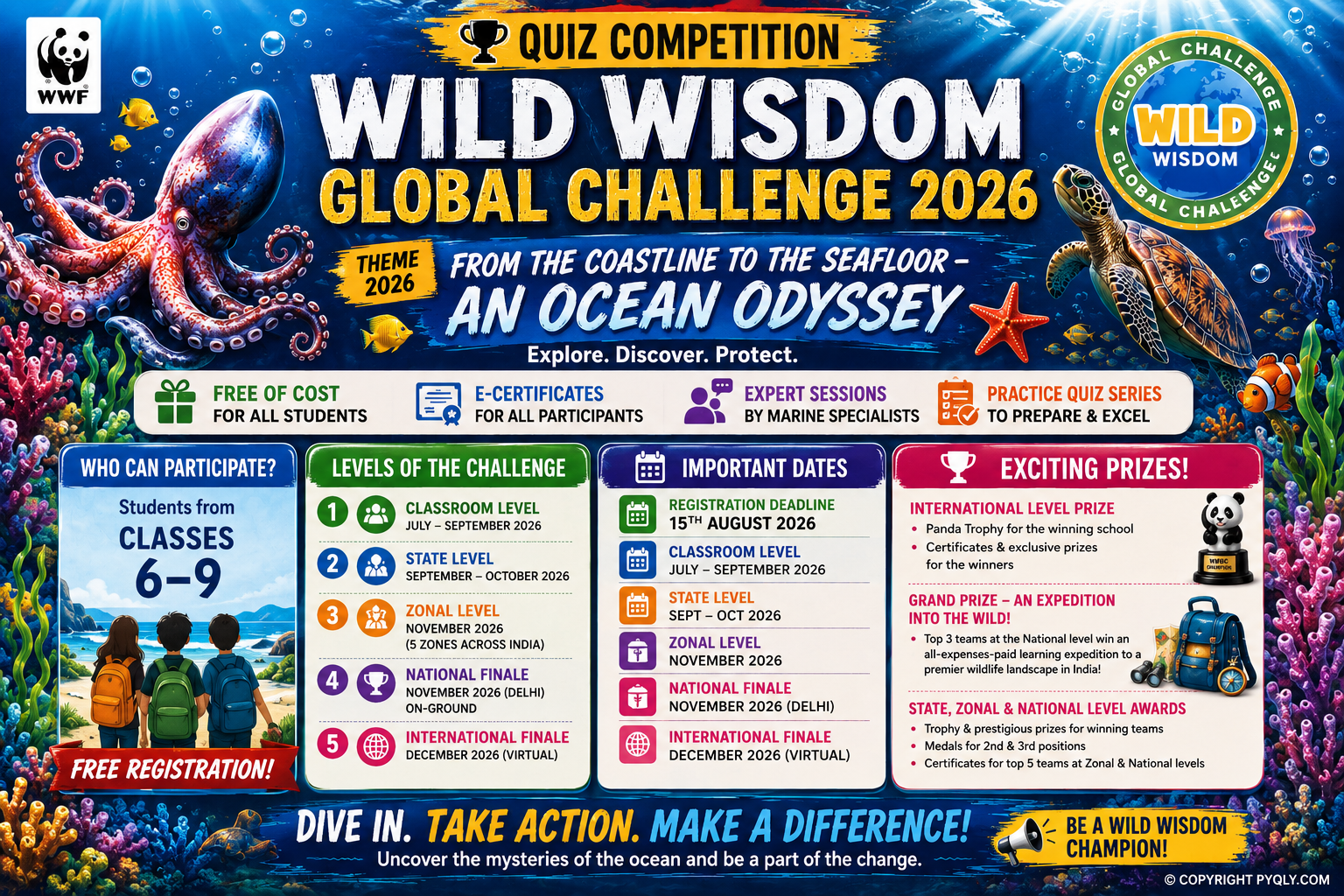
Imagine discovering glowing jellyfish, giant blue whales, mysterious deep-sea creatures, coral reefs, and underwater forests—all while participating in one of the world’s largest environmental learning challenges.
That is exactly what the WWF Wild Wisdom Global Challenge 2026 (WWGC), organized by WWF-India, offers. At PYQLY.COM, we believe that true learning goes beyond textbooks, and this initiative perfectly bridges academic curiosity with real-world conservation.
More than a quiz competition, WWGC is an educational journey that encourages students to understand biodiversity, appreciate nature, and become responsible environmental stewards. Since its launch in 2008, the initiative has inspired students through engaging quizzes, interactive learning resources, and expert-led sessions focused on wildlife and conservation.
For the 2026 edition, the challenge explores the oceans under the theme “From the Coastline to the Seafloor – An Ocean Odyssey.” The programme is open to students of Classes 6 to 9, and participation is completely free for schools and students. Official materials note that previous editions drew participation from over 500,000 students across 4,500 schools and extended to participants from 57 countries.
What is the Wild Wisdom Global Challenge?
The Wild Wisdom Global Challenge (WWGC) is WWF-India’s flagship annual environmental education initiative. It combines structured learning with friendly competition to help young minds explore wildlife, ecosystems, and conservation principles.
Unlike traditional academic competitions, WWGC emphasizes learning before testing. It achieves this by supplying curated preparation materials, practice quizzes, and interactive sessions led by wildlife experts long before the first elimination round begins.
Key Objectives of WWGC:
- Encourage natural curiosity about the environment.
- Build scientific literacy and environmental awareness.
- Promote critical thinking skills through ecological problem-solving.
- Inspire students to take actionable steps toward conservation.
Why WWGC Matters: Understanding Ocean Conservation
Oceans cover approximately 71% of the Earth’s surface, yet vast stretches of the seafloor remain completely unexplored. Scientists estimate that the marine realm supports around 2.2 million species, but fewer than one-tenth have been formally identified.

Oceans are not just vast reservoirs of saltwater; they actively maintain the planet’s life support systems. Marine plankton generate a significant portion of the oxygen we breathe, while oceanic currents drive global climate and weather patterns.
By centering the 2026 edition on marine ecosystems, WWGC helps students connect daily human actions with the health of distant marine habitats facing severe threats from plastic pollution, climate change, and habitat destruction.
WWGC 2026 Theme: Ocean Odyssey
The 2026 theme, “From the Coastline to the Seafloor – An Ocean Odyssey,” takes students on an underwater journey. Participants move beyond surface-level facts to explore complex ecological relationships, evolutionary adaptations, and deep-sea mysteries—such as the pale deep-sea octopus nicknamed “Casper.”
The Six Official Learning Themes
WWF-India organizes the preparation content across six core domains:

1. Marine Diversity and Distribution
Focuses on the vast spectrum of life in oceanic waters. Students explore global marine biodiversity hotspots, including the Coral Triangle, the Great Barrier Reef, and the Mesoamerican Reef, understanding why species richness varies across regions.
2. World Beneath the Waves
Examines distinct marine habitats. From shallow mangrove forests and kelp beds to abyssal seafloors and underwater cave systems, this theme highlights how habitat diversity drives ecosystem stability.
3. Life Functions Underwater
Covers the physiological processes of marine life. Students analyze how aquatic organisms breathe, feed, reproduce, regulate salt balance, and sense their surroundings in dense underwater environments.
4. Adaptations and Behaviour
Showcases the evolutionary traits developed for survival. Examples include:
- Fish that generate electric fields to navigate murky waters.
- Lobsters capable of regenerating lost limbs.
- Sea kraits with flattened, paddle-like tails for swimming.
- Sea turtles navigating thousands of miles across open ocean to reach nesting grounds.
- Seabirds plunge-diving at high speeds to capture prey.
5. Challenges to Ocean Health
Directly addresses ecological threats such as coral bleaching, microplastic accumulation, sea temperature rise, and the plight of critically endangered species like the vaquita.
6. Human–Ocean Interactions and Conservation Stewardship
Explores practical solutions. Aligned with WWF-India’s Oceans & Coasts programme, this area looks at sustainable fisheries, marine protected areas, community partnerships, and environmental policy.
Eligibility and Registration Guidelines

The Wild Wisdom Global Challenge follows strict eligibility guidelines to maintain accessibility for schools nationwide.
| Parameter | Official Details |
| Eligible Classes | Classes 6, 7, 8, and 9 |
| Registration Fee | Completely Free (₹0) |
| Registration Pathway | Exclusively via participating schools |
| Teacher Coordinator | 1 Mandatory Coordinator per registered school |
| Registration Deadline | 15 August 2026 (As per official 2026 documents) |
Important Source Note on Minimum Registrations:
The uploaded official WWGC documents show a slight discrepancy regarding school registration numbers. The official FAQ document specifies a minimum requirement of 40 students per school, whereas a separate official website export lists 50 students per school. Schools registering should verify the exact student threshold directly with WWF-India during sign-up.
The Five Levels of the Competition
The competition progresses through five distinct stages, transitioning from school-level online evaluations to an international finale.
Level 1: Classroom Level (Virtual)
- Format: Series of online multiple-choice quizzes on the WWGC platform.
- Mechanism: Cumulative scores across practice and official rounds determine top candidates.
- Outcome: The top 2 students from each qualifying classroom advance.
- Timeline: July – September 2026.
Level 2: State Level (Virtual)
- Format: Digital assessment among qualified school champions across each state.
- Outcome: Winning student pairs form the official State Team.
Level 3: Zonal Level (On-Ground)
- Format: Live, interactive competitive rounds across 5 physical zones in India.
- Outcome: Zonal winners earn spots at the national stage.
Level 4: National Finale (On-Ground)
- Format: In-person championship event hosted in New Delhi.
- Outcome: The overall National Champion team is selected to represent the country.
Level 5: International Finale (Virtual)
- Format: Virtual showdown matching India’s National Champions against country winners from around the globe.
- Outcome: Crowned Global Champions of the Wild Wisdom Challenge.
Awards, Recognition, and Grand Prizes
WWGC ensures that achievements at every tier are formally recognized:
- Classroom Level: All participating students earn an official digital Certificate of Participation.
- State, Zonal & National Levels: Qualifying participants and top performers receive official trophies, medals, merit certificates, and special prize kits.
- Grand Prize (Wild Explorer Experience): The top-performing teams at the National Level win an all-expenses-paid educational expedition to a premier Indian National Park or Nature Reserve. The winning school’s Teacher Coordinator is also invited on this learning journey.
Official Preparation Resources and Study Material
To support participants, WWF-India provides multiple learning platforms:
- WWGC Resource Centre: Offers downloadable thematic briefs, reading lists, and bibliographies corresponding to the six Ocean Odyssey themes.
- ITZA Learning Portal: Features curated digital learning pathways tailored specifically for WWGC preparation.
- One Planet Academy (OPA): Provides interactive infographics, conservation webinars, and short environmental courses.
Student Preparation Checklist
  [ ] Step 1: Study all 6 Ocean Odyssey thematic modules.
  [ ] Step 2: Download official briefs from the WWGC Resource Centre.
  [ ] Step 3: Complete interactive practice quizzes on the ITZA Portal.
  [ ] Step 4: Attend live/recorded WWF expert webinars on marine biology.
  [ ] Step 5: Review marine terminology, ecosystems, and adaptations.
  [ ] Step 6: Focus on conceptual understanding over memorization.
Key Dates & Timeline Overview
| Activity Phase | Officially Listed Timeline |
| Registration Deadline | 15 August 2026 |
| Classroom Level Quizzes | July – September 2026 |
| State Level Assessment | September – October |
| Zonal Level Round | November 2026 |
| National Finale | November 2026 |
| International Finale | December 2026 |
Frequently Asked Questions (FAQs)
1. What is the official theme for the Wild Wisdom Global Challenge 2026?
The 2026 theme is “From the Coastline to the Seafloor – An Ocean Odyssey.” It covers marine biodiversity, ocean habitats, biological adaptations, ocean health challenges, and conservation stewardship.
2. Which students are eligible to join WWGC 2026?
Students currently enrolled in Classes 6, 7, 8, and 9 are eligible to participate.
3. Is there any fee to register or participate in WWGC 2026?
No, participation is 100% free for both schools and individual students.
4. Can an individual student register directly without a school?
No, registration must be managed through participating schools. Each school assigns a mandatory Teacher Coordinator to oversee student sign-ups.
5. How many levels are included in the 2026 challenge?
There are 5 stages: Classroom Level (Virtual), State Level (Virtual), Zonal Level (On-ground), National Finale (On-ground), and the International Finale (Virtual).
6. What format is used for the Classroom Level?
The Classroom Level consists of online, multiple-choice quizzes hosted on the WWGC digital platform. Cumulative scores determine which students qualify for the next level.
7. What is the Wild Explorer Experience?
The Wild Explorer Experience (also termed the Signature Wild Experience) is the grand prize for top National Level teams. It is an all-expenses-paid educational trip to an iconic National Park or Nature Reserve, accompanied by their Teacher Coordinator.
8. Where can students find official preparation materials?
Students can access preparation resources through the official WWGC Resource Centre, the ITZA Learning Portal, and WWF-India’s One Planet Academy.
Conclusion
The WWF Wild Wisdom Global Challenge 2026 is an incredible platform for young learners in Classes 6 through 9 to explore the blue planet. By moving beyond simple rote memorization, the Ocean Odyssey theme inspires genuine curiosity about underwater ecosystems, biological adaptations, and marine conservation.
Whether you are a student eager to learn about deep-sea marine life, a teacher guiding future scientists, or a school looking to promote environmental literacy, WWGC 2026 provides an enriching educational path.
To keep exploring educational opportunities, access chapter study guides, and test your knowledge with interactive practice quizzes, visit us at PYQLY.COM—your partner in structured learning.