Focus Keyword: National Standard Examination (NSE) 2026
Reading Time: 10–12 Minutes
Introduction
Every year, thousands of talented students across India dream of representing the country at the International Science Olympiads. The journey to these prestigious competitions begins with a single examination—the National Standard Examination (NSE).
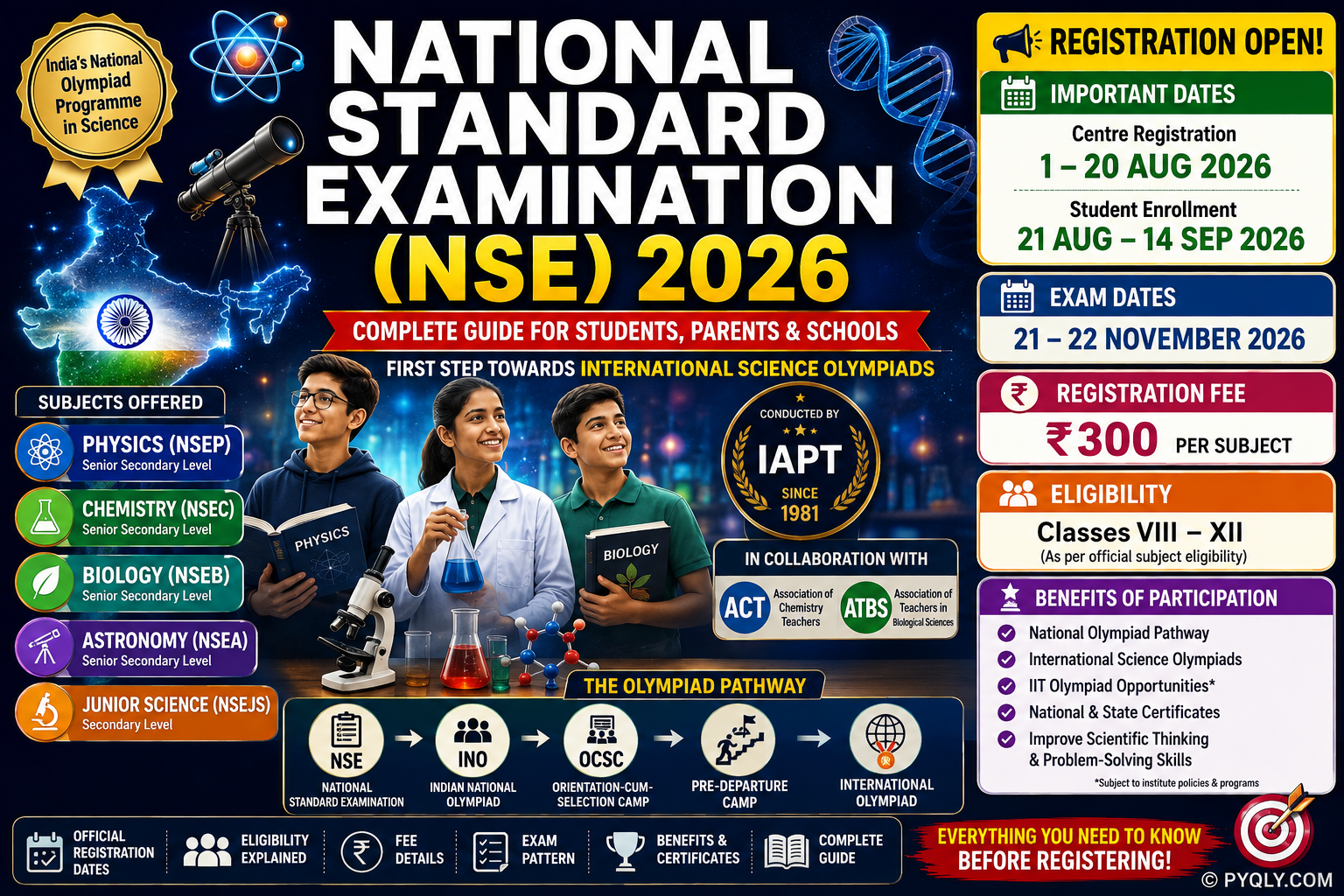
The National Standard Examination (NSE) 2026 is the first stage of India’s National Olympiad Programme in Science. It is conducted by the Indian Association of Physics Teachers (IAPT), with partner organizations for Chemistry and Biology, and provides a structured pathway for scientifically talented students to compete at the national and international levels.
Recognizing its importance, Kendriya Vidyalaya Sangathan (KVS) has instructed all Kendriya Vidyalayas to publicize the examination, register eligible schools as examination centres, encourage student participation, and ensure timely registration and enrollment.
This guide, based on the uploaded official KVS circulars and IAPT publications, explains everything you need to know about NSE 2026—from its purpose and subjects to the examination timeline and benefits.
Table of Contents
- What is the National Standard Examination (NSE)?
- About the National Olympiad Programme
- Who Conducts NSE?
- Why Should Students Participate?
- Subjects Offered in NSE 2026
- Examination Schedule
- Important Dates at a Glance
- Key Highlights
What is the National Standard Examination (NSE)?
The National Standard Examination (NSE) is the first stage of the National Olympiad Programme in Science in India. It is designed to identify students with strong scientific aptitude and conceptual understanding and provide them with opportunities to progress through higher stages of the Olympiad programme.
According to the official KVS circular, students who qualify successive stages may ultimately represent India in the International Science Olympiads.
The official IAPT booklet further explains that the Olympiads are intended to:
- Encourage deep conceptual understanding.
- Develop scientific thinking.
- Promote logical reasoning and problem-solving.
- Inspire students to pursue excellence in science.
- Build a pathway from school-level learning to international scientific competitions.
Unlike many competitive examinations that focus primarily on speed or memorization, NSE emphasizes conceptual clarity and the application of scientific knowledge.
The National Olympiad Programme: A Pathway to International Excellence
The National Standard Examination is only the beginning of a multi-stage selection process.
The official booklet describes the progression as follows:
- National Standard Examination (NSE)
- Indian National Olympiad (INO)
- Orientation-cum-Selection Camp (OCSC)
- Pre-departure Training Camp
- International Science Olympiad
At each stage, the number of participants narrows, and students are evaluated on increasingly advanced scientific knowledge and problem-solving skills. Those selected at the final stage represent India in international competitions.
Why Do Science Olympiads Matter?
The official IAPT booklet emphasizes that the International Science Olympiads bring together talented school students from around the world in a friendly yet intellectually demanding environment. Beyond competition, they encourage scientific curiosity, collaboration, and lifelong engagement with science.
For students, participating in the Olympiad programme can help:
- Build confidence in scientific reasoning.
- Strengthen analytical and logical thinking.
- Explore science beyond the regular school curriculum.
- Experience challenging, concept-based questions.
- Compete with talented students from across India.
The booklet also notes that the examinations are intended to assess conceptual understanding, logical reasoning, laboratory skills, and the ability to apply knowledge to new situations, and states that they do not require special coaching, although sincere classroom learning is important.
Who Conducts NSE 2026?
The National Standard Examination is coordinated by the Indian Association of Physics Teachers (IAPT).
For different subjects, IAPT works in collaboration with:
- Association of Chemistry Teachers (ACT) – Chemistry
- Association of Teachers in Biological Sciences (ATBS) – Biology
According to the official booklet, IAPT is an organization of physics teachers and professionals dedicated to promoting the teaching and learning of physics in India. It has been conducting National Standard Examinations for decades as part of its academic activities.
Subjects Offered in NSE 2026
Students can participate in one of five National Standard Examinations depending on their eligibility.
| Examination | Subject | Intended Level* |
|---|---|---|
| NSEP | Physics | Senior Secondary |
| NSEC | Chemistry | Senior Secondary |
| NSEB | Biology | Senior Secondary |
| NSEA | Astronomy | Senior Secondary |
| NSEJS | Junior Science | Secondary |
*The syllabus levels are based on the official booklet and brochure. Detailed eligibility will be covered in Part 2.
Examination Schedule for NSE 2026
The official schedule is as follows:
| Examination | Date | Time |
|---|---|---|
| NSEA (Astronomy) | 21 November 2026 | 2:30 PM – 4:30 PM |
| NSEP (Physics) | 22 November 2026 | 8:30 AM – 10:30 AM |
| NSEC (Chemistry) | 22 November 2026 | 11:30 AM – 1:30 PM |
| NSEB (Biology) | 22 November 2026 | 2:30 PM – 4:30 PM |
| NSEJS (Junior Science) | 22 November 2026 | 2:30 PM – 4:30 PM |
A notable point from the official schedule is that NSEB and NSEJS are held at the same time, and the student brochure specifies that a student cannot appear for both Junior Science and the Senior NSE examinations.
Important Dates at a Glance
| Activity | Official Date |
|---|---|
| Centre Registration Opens | 1 August 2026 |
| Centre Registration Closes | 20 August 2026 |
| Student Enrollment Begins | 21 August 2026 |
| Student Enrollment Ends | 14 September 2026 |
| Examinations | 21–22 November 2026 |
| Score Card Publication | 24 December 2026 |
| Grievance Window | 48 hours after score cards |
| Final Shortlist | 30 December 2026 |
These dates are specified in the KVS circular and the IAPT information sheet.
Why Has KVS Issued This Circular?
Kendriya Vidyalaya Sangathan has formally instructed its Regional Offices and Kendriya Vidyalayas to support the successful conduct of NSE 2026. According to the uploaded circulars, schools are expected to:
- Inform students and teachers about the examination.
- Encourage eligible students to participate.
- Register eligible Kendriya Vidyalayas as examination centres.
- Nominate a Centre In-charge for examination-related activities.
- Display the official NSE poster on school notice boards.
- Complete registration and enrollment within the prescribed schedule.
Key Highlights of NSE 2026
- First stage of India’s National Olympiad Programme in Science.
- Conducted offline at registered examination centres.
- Covers Physics, Chemistry, Biology, Astronomy, and Junior Science.
- Centre registration runs from 1–20 August 2026, followed by student enrollment from 21 August–14 September 2026.
- Examination fee is ₹300 per student per subject, with ₹60 per student per subject allocated to the examination centre for conduct-related expenses.
- Successful students may advance to the Indian National Olympiads and subsequent stages leading to international representation.
Eligibility Criteria for NSE 2026
One of the most important aspects of the National Standard Examination is ensuring that students apply for the correct examination based on their class and age.
According to the official IAPT student brochure, eligibility differs for the Senior Science examinations (Physics, Chemistry, Biology and Astronomy) and the Junior Science examination (NSEJS).
Eligibility for Senior NSE Examinations
The following examinations fall under the senior category:
- National Standard Examination in Physics (NSEP)
- National Standard Examination in Chemistry (NSEC)
- National Standard Examination in Biology (NSEB)
- National Standard Examination in Astronomy (NSEA)
The brochure states that these examinations are intended for Indian students studying in Classes XII, XI and X who satisfy the prescribed date-of-birth criteria specified for NSE 2026.
| Examination | Eligible Classes* |
|---|---|
| NSEP | XII, XI & X |
| NSEC | XII, XI & X |
| NSEB | XII, XI & X |
| NSEA | XII, XI & X |
*Subject to the age/date-of-birth conditions mentioned in the official brochure.
Eligibility for NSEJS
The National Standard Examination in Junior Science (NSEJS) is intended for younger students.
According to the brochure, it is meant for Indian students studying in:
- Class X
- Class IX
- Class VIII
who satisfy the prescribed age criteria.
Important Restriction
The official brochure contains an important rule:
A student appearing for Junior Science (NSEJS) cannot appear for any Senior NSE examination, and vice versa.
Since NSEB and NSEJS are scheduled at the same time, students must choose the examination that matches their eligibility and academic goals.
Registration Process
The registration process has two distinct stages.
Stage 1: Centre Registration
Before students can register, schools wishing to serve as examination centres must complete Centre Registration.
Registration Period
1 August 2026 – 20 August 2026
During this period, the school:
- Registers itself online.
- Appoints one teacher as the Centre In-charge.
- Completes institution details on the IAPT portal.
The official information sheet notes that there is no charge for centre registration.
Who is the Centre In-charge?
Every participating school designates a teacher as the Centre In-charge.
The Centre In-charge is responsible for:
- Registering the institution.
- Coordinating student enrollment.
- Communicating with IAPT.
- Conducting the examination according to official instructions.
- Managing examination-related documentation.
KVS has directed Kendriya Vidyalayas to nominate a Centre In-charge for these responsibilities.
Stage 2: Student Enrollment
Once a school is registered, student enrollment begins.
Enrollment Period
21 August 2026 – 14 September 2026
According to the official documents, enrollment is completed online through iapt.org.in.
Students may enroll:
- through the Centre In-charge (group enrollment), or
- individually online, where applicable.
Information Required During Enrollment
The official information sheet specifies that each student must provide:
- Full name
- Required academic details
- Phone number
- Email ID
This information is required for every individual participant.
Examination Fee
The official KVS circular clearly states:
₹300 per student per subject.
The IAPT information sheet further explains that:
- ₹60 per student per subject is paid to the examination centre to meet conduct-related expenses.
| Item | Amount |
|---|---|
| Examination Fee | ₹300 |
| Amount provided to Centre | ₹60 |
Students registering for more than one eligible senior subject should note that the fee is charged per subject.
Minimum Requirement for Schools to Become Examination Centres
The official information sheet specifies that a school can function as an examination centre if it has:
- At least 30 students in one subject, or
- 40 students in total across all subjects.
This helps ensure efficient conduct of the examination.
Mode of Examination
According to the KVS circular, NSE 2026 will be conducted:
- Offline
- At registered examination centres
- Under the supervision of the designated Centre In-charge.
Examination Pattern
The official booklet describes a two-part objective paper.
Part A
- 48 multiple-choice questions
- Four options for each question
- 3 marks for every correct answer
- −1 mark for every incorrect answer
The focus is on conceptual understanding rather than rote memorization.
Part B
Part B is designed to test deeper analytical ability.
According to the booklet:
- 12 questions
- Multiple correct options may be present
- 6 marks for each question
- No negative marking
- Full credit is awarded only if all correct options and no incorrect options are marked.
Marking Scheme Summary
| Section | Questions | Marks per Question | Negative Marking |
|---|---|---|---|
| Part A | 48 | 3 | Yes (−1) |
| Part B | 12 | 6 | No |
What Skills Does NSE Test?
The official booklet indicates that the examination is intended to evaluate:
- Conceptual understanding
- Scientific reasoning
- Logical thinking
- Problem-solving ability
- Application of classroom knowledge
- Analytical skills
Rather than emphasizing memorization, the questions encourage students to apply scientific principles to unfamiliar situations.
Syllabus Overview
The uploaded documents provide only a broad overview rather than chapter-wise syllabi.
Physics (NSEP)
Questions are generally based on concepts taught at the senior secondary level, with emphasis on applying principles to solve problems.
Chemistry (NSEC)
The examination assesses conceptual understanding across major areas of chemistry covered in the senior secondary curriculum.
Biology (NSEB)
The syllabus broadly aligns with biology taught at the senior secondary level, emphasizing understanding rather than recall.
Astronomy (NSEA)
According to the booklet, Astronomy draws significantly on Physics and Mathematics, along with elementary astronomy concepts.
Junior Science (NSEJS)
NSEJS is based on science taught at the secondary level and integrates concepts from Physics, Chemistry and Biology.
Note: The uploaded documents do not include a chapter-wise syllabus. Students should refer to the official syllabus document available through the organizers for detailed topic lists.
Language of the Examination
The uploaded KVS circulars, brochure, and booklet explain the examination schedule, registration, eligibility, and pattern. However, they do not specify the language(s) in which the question papers will be available. Therefore, this article does not make any unsupported claim regarding language options.
Practical Tips for Students
Based on the nature of the examination described in the official booklet:
- Focus on understanding scientific concepts instead of memorizing facts.
- Practice solving application-based questions.
- Complete registration before the deadline.
- Verify your eligibility carefully before selecting a subject.
- Keep your email ID and phone number ready for enrollment.
- Coordinate with your school’s Centre In-charge if registering through the school.
Guidance for Schools and Kendriya Vidyalayas
The KVS circular requests schools to take proactive steps to facilitate participation:
- Inform students, teachers, and parents about NSE 2026.
- Register eligible schools as examination centres within the prescribed period.
- Nominate a Centre In-charge.
- Display the official NSE poster on school notice boards.
- Ensure student enrollment is completed before the deadline.
- Encourage scientifically inclined students to participate.
From NSE to International Olympiad: Understanding the Selection Journey
Qualifying the National Standard Examination (NSE) is a significant achievement, but it is only the beginning of a rigorous multi-stage selection process designed to identify India’s most talented young scientists.
According to the official IAPT booklet, the progression is:
| Stage | Examination/Programme | Purpose |
|---|---|---|
| Stage 1 | National Standard Examination (NSE) | Initial screening of students |
| Stage 2 | Indian National Olympiad (INO) | Selection of the country’s best performers |
| Stage 3 | Orientation-cum-Selection Camp (OCSC) | Advanced training and final team selection |
| Stage 4 | Pre-departure Camp | Intensive preparation for international competition |
| Stage 5 | International Science Olympiad | Representation of India |
Each stage becomes progressively more competitive, with only a limited number of students advancing.
How Students Are Shortlisted After NSE
The official information sheet specifies the number of students shortlisted for the second stage:
| Subject | Students Shortlisted |
|---|---|
| Physics (INPhO) | 400 |
| Chemistry (INChO) | 400 |
| Biology (INBO) | 400 |
| Astronomy (INAO) | 500 |
| Junior Science (INJSO) | 300 |
For Physics, Chemistry, Biology, and Astronomy, the shortlisted students are further distributed across eligible class groups, and the official information also mentions a 15% horizontal reservation for female students, along with state-wise quotas published by the organizers.
Certificates and Recognition
Participation in NSE is valuable even for students who do not progress to later stages. According to the official documents, certificates are awarded to:
- Top 10% students at each examination centre.
- National Top 1% of total enrollment.
- State Top 1% of enrollment within each state.
- Students shortlisted for the next stage of the Olympiad programme.
These recognitions acknowledge strong academic performance and encourage students to continue pursuing excellence in science.
Why Participate in NSE?
Beyond certificates, the Olympiad programme offers several educational benefits.
1. Concept-Based Learning
Unlike examinations that emphasize memorization, NSE challenges students to understand scientific principles and apply them to unfamiliar situations. The official booklet highlights conceptual understanding, analytical thinking, and problem-solving as key objectives.
2. National-Level Competition
Students compete with peers from across the country, providing an opportunity to benchmark their understanding and learn from a broader academic community.
3. Advanced Scientific Exposure
Students who progress through the Olympiad stages receive advanced training and exposure to higher-level scientific concepts.
4. International Representation
The final stage offers the opportunity to represent India at the International Science Olympiads, a prestigious achievement recognized worldwide.
Olympiad-Based Admission Opportunities to IITs
One of the uploaded documents highlights that several Indian Institutes of Technology (IITs) have introduced admission pathways based on Olympiad achievements for the academic year referenced in that document. These opportunities are governed by each institute’s own admission policy and may change from year to year.
The uploaded document mentions:
| IIT | Admission Channel Mentioned |
|---|---|
| IIT Madras | Science Olympiad Excellence Admissions (SCOPE) |
| IIT Kanpur | Olympiad Admission Channel |
| IIT Gandhinagar | Olympiad Admission |
| IIT Bombay | BS Mathematics through Indian National Mathematical Olympiad |
| IIT Indore | Sports Excellence Admission (SEA) |
Important: The uploaded document specifically pertains to the admission cycle stated within it. Students should always consult the latest admission notifications issued by the respective IITs before making decisions.
How to Prepare Effectively for NSE
While the official documents do not prescribe a preparation strategy, they emphasize conceptual understanding rather than rote learning. Based on that emphasis, students can adopt the following evidence-aligned approach:
Build Strong Fundamentals
Understand the concepts taught in school thoroughly before attempting advanced problems.
Practice Analytical Questions
Regularly solve application-based and reasoning-oriented questions that require interpreting scientific principles.
Revise Consistently
Prepare a realistic revision schedule and revisit important topics regularly to reinforce understanding.
Strengthen Problem-Solving Skills
Olympiad questions often combine concepts from different areas of science. Practice integrating knowledge rather than studying topics in isolation.
Manage Time During the Examination
Become familiar with the examination pattern so that you can allocate time wisely across different sections.
Common Mistakes to Avoid
Students preparing for NSE should be mindful of the following:
| Mistake | Better Approach |
|---|---|
| Memorizing without understanding | Focus on concepts and reasoning |
| Ignoring registration deadlines | Complete enrollment well before the last date |
| Choosing the wrong examination | Verify eligibility carefully |
| Neglecting weaker topics | Prepare a balanced study plan |
| Overlooking official instructions | Read the brochure and examination guidelines carefully |
Guidance for Parents
Parents play an important role in supporting students throughout the preparation process.
They can help by:
- Encouraging curiosity rather than focusing solely on scores.
- Ensuring timely registration.
- Providing a quiet environment for study.
- Supporting a balanced routine that includes rest and recreation.
- Motivating students even if they do not qualify for subsequent stages.
The Olympiad programme is designed to nurture scientific talent over time, and participation itself is a valuable learning experience.
Guidance for Schools and Teachers
The KVS circular requests schools to actively support NSE 2026 by:
- Informing students and parents about the examination.
- Registering as examination centres where eligible.
- Appointing a Centre In-charge.
- Completing registrations within the prescribed timelines.
- Displaying the official NSE poster.
- Encouraging scientifically inclined students to participate.
Teachers can also guide students by identifying those with strong conceptual understanding and encouraging them to participate.
Frequently Asked Questions (FAQs)
1. What is the National Standard Examination (NSE)?
It is the first stage of India’s National Olympiad Programme in Science and serves as the initial selection examination for students aspiring to participate in national and international science Olympiads.
2. Who conducts NSE?
The National Standard Examination is conducted by the Indian Association of Physics Teachers (IAPT) in collaboration with partner organizations for relevant subjects.
3. Is NSE conducted online?
No. According to the KVS circular, NSE 2026 will be conducted offline at registered examination centres.
4. What is the examination fee?
The examination fee is ₹300 per student per subject, with ₹60 per student per subject allocated to the examination centre for conduct-related expenses.
5. Can a student appear in both NSEJS and a Senior NSE examination?
No. The official brochure clearly states that students must choose either the Junior Science examination or a Senior NSE examination.
6. When will score cards be released?
The official schedule indicates that score cards will be published on 24 December 2026, followed by a 48-hour grievance window and the final shortlist on 30 December 2026.
7. How many students qualify for the next stage?
The number depends on the subject. The official information sheet specifies 400 students each for Physics, Chemistry, and Biology; 500 for Astronomy; and 300 for Junior Science, subject to the published selection criteria.
8. Does qualifying NSE guarantee admission to an IIT?
No. The uploaded documents mention Olympiad-based admission opportunities offered by certain IITs for a specific admission cycle, but each institute has its own eligibility criteria and admission process. Students must refer to the latest official notifications of the respective IITs.
Conclusion
The National Standard Examination (NSE) 2026 is much more than a competitive examination—it is an opportunity for students to deepen their understanding of science, challenge themselves academically, and become part of one of India’s most prestigious science talent programmes.
With support from Kendriya Vidyalaya Sangathan, participation in NSE is expected to expand across Kendriya Vidyalayas, providing more students with the chance to explore scientific excellence. Whether a student advances to later Olympiad stages or not, the preparation process itself strengthens conceptual learning, analytical thinking, and confidence—qualities that benefit them throughout their academic journey.
For students, parents, and schools, the key is to understand the eligibility rules, complete registration within the prescribed timeline, and prepare with a focus on concepts rather than memorization.
Final Key Takeaways
- NSE 2026 is the first stage of India’s National Olympiad Programme in Science.
- It includes Physics, Chemistry, Biology, Astronomy, and Junior Science examinations.
- Registration begins with centre registration, followed by student enrollment through the official process.
- The examination is offline and emphasizes conceptual understanding.
- Successful students progress through the Indian National Olympiads, Orientation-cum-Selection Camp, and potentially to the International Science Olympiads.
- Recognition includes certificates for top performers at the centre, state, and national levels, as well as students shortlisted for subsequent stages.
This completes the three-part, publication-ready guide based on the uploaded official KVS and IAPT documents, with unsupported claims intentionally excluded or clearly qualified.