Introduction
Science has always been one of humanity’s most powerful tools for understanding the world and solving everyday problems. However, the challenges faced by society today—such as climate change, environmental pollution, resource depletion, food security, water scarcity, and increasing energy demand—require not only scientific knowledge but also innovative thinking that leads to sustainable solutions.
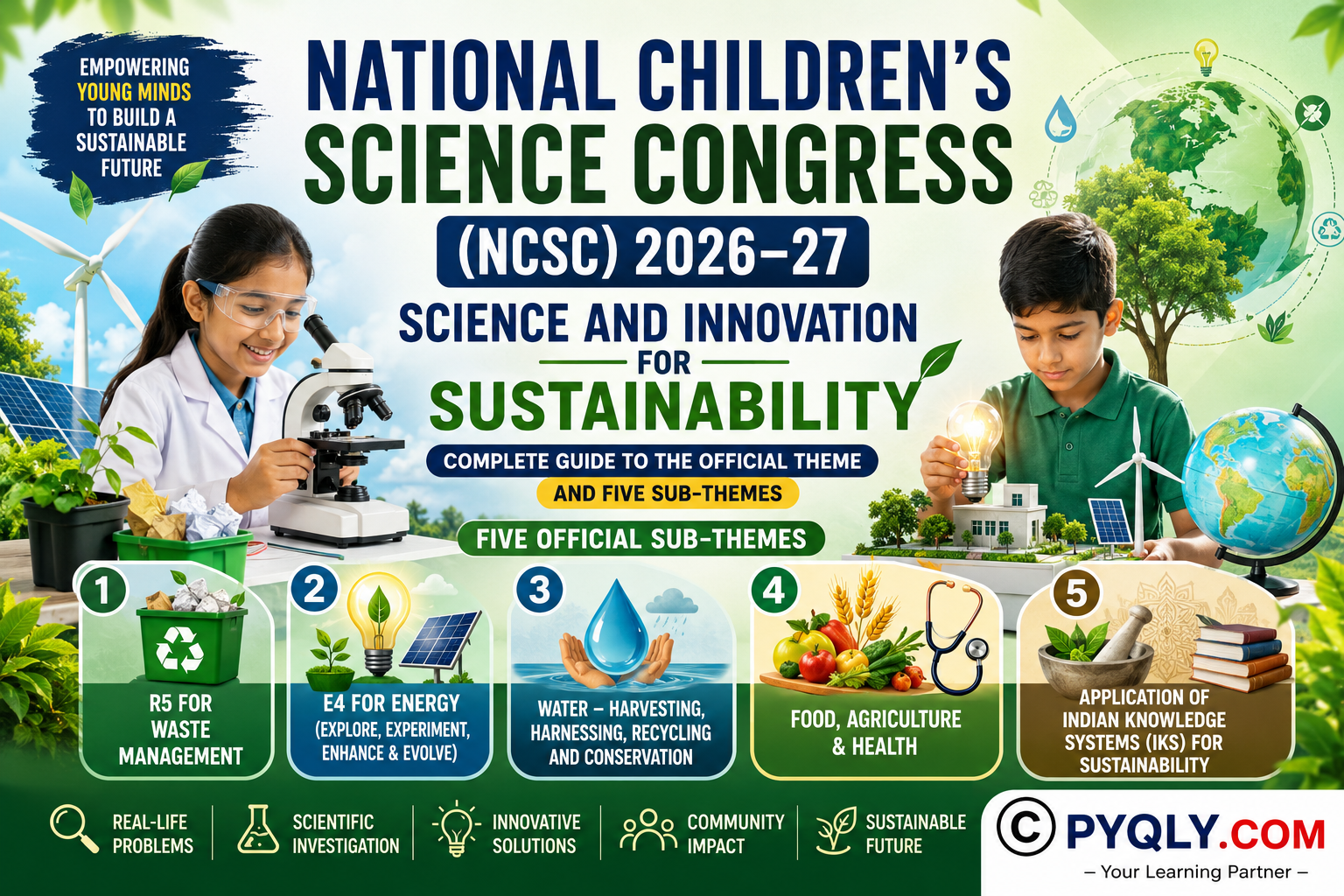
Recognizing this need, the National Children’s Science Congress (NCSC) 2026–27 has adopted the inspiring focal theme “Science and Innovation for Sustainability.” The theme encourages young minds to observe their surroundings, identify real-life local problems, investigate them scientifically, and develop practical, affordable, and community-oriented solutions. Rather than focusing on theoretical science alone, NCSC motivates children to apply scientific methods to issues that directly affect their neighbourhoods and communities. This people-centric approach has remained the hallmark of the programme since its inception and continues to guide its activities today.
Welcome to PYQLY.COM, where we are committed to providing authentic, well-researched, and student-friendly educational resources. This comprehensive guide has been prepared using the official NCSC Programme Guidelines and the National Children’s Science Congress Activity Guidebook 2026–2027. Our aim is to help students, teachers, mentors, parents, and school administrators understand the official theme in depth so they can plan meaningful research projects aligned with the expectations of the National Children’s Science Congress.
Unlike many brief summaries available online, this guide goes beyond simply listing the five sub-themes. We explain why the theme was selected, how it connects with sustainable development, what opportunities it offers for young researchers, and how students can choose the most appropriate research direction based on local issues and scientific inquiry. Throughout the article, the emphasis remains on understanding the philosophy behind NCSC rather than merely selecting a project title.
Whether you are participating in the Children’s Science Congress for the first time or preparing for district, state, or national-level presentations, understanding the official theme is the first and most important step toward developing a successful research project.
Table of Contents
Understanding the National Children’s Science Congress
The National Children’s Science Congress (NCSC) is one of India’s most significant science education programmes designed specifically for children between the ages of 10 and 17 years. It is a flagship initiative of the National Council for Science and Technology Communication (NCSTC), Department of Science and Technology (DST), Government of India. Since its inception in 1993, the programme has encouraged children to explore science through observation, experimentation, research, and community engagement rather than relying solely on textbook learning.
The philosophy of NCSC is simple yet powerful: children learn science most effectively by doing science. Instead of preparing static models or memorizing facts, participants investigate real problems that exist in their own surroundings. They collect evidence, design experiments or surveys, analyze data, interpret results, and suggest practical solutions using scientific methods. This experiential approach helps students develop curiosity, critical thinking, creativity, teamwork, communication skills, and social responsibility.
Another distinguishing feature of NCSC is its emphasis on local relevance. Every project is expected to emerge from issues observed within the child’s own neighbourhood, school, village, town, or city. Such locally grounded investigations ensure that the research remains meaningful and that the findings can potentially benefit the surrounding community.
Why Themes Matter in National Children’s Science Congress (NCSC)
Each edition of the National Children’s Science Congress is organized around a carefully selected focal theme. The theme provides a broad scientific direction while allowing students the freedom to investigate diverse local issues. It acts as a common framework that connects thousands of projects undertaken across India while still encouraging originality and regional diversity.
A well-defined theme serves several important purposes:
- It focuses students’ attention on issues of national and global importance.
- It promotes interdisciplinary thinking by integrating science with society, technology, and the environment.
- It encourages project ideas that address practical problems rather than purely theoretical concepts.
- It provides evaluators with a consistent framework for assessing relevance.
- It helps young researchers understand how local actions contribute to larger societal goals.
The official Activity Guidebook explains that the current theme was chosen after extensive deliberations by the National Academic Committee. It encompasses areas related to sustainable development, including waste management, energy, water, food, agriculture, health, and Indian Knowledge Systems. These domains are intended to inspire child scientists to develop innovative, research-driven projects with creativity and scientific rigor.
What Is the Official Theme of National Children’s Science Congress (NCSC) 2026–27?
The official focal theme for the National Children’s Science Congress (NCSC) 2026–27 is:
Science and Innovation for Sustainability
At first glance, this title appears straightforward. However, each of the three words—Science, Innovation, and Sustainability—represents a broad concept with significant meaning.
Science provides the systematic method for understanding problems through observation, experimentation, measurement, and logical reasoning.
Innovation encourages creative thinking that transforms scientific understanding into practical, affordable, and useful solutions.
Sustainability reminds us that development should meet present needs without compromising the ability of future generations to meet theirs. It emphasizes responsible use of natural resources, environmental protection, social well-being, and long-term resilience.
By combining these ideas, the NCSC theme encourages child scientists not only to investigate problems scientifically but also to think creatively about sustainable solutions that benefit both people and the planet.
Understanding “Science and Innovation for Sustainability”
The theme “Science and Innovation for Sustainability” is much more than a slogan. It reflects a way of thinking that encourages young minds to use scientific knowledge and creative ideas to solve real-world problems while protecting natural resources for future generations. The National Children’s Science Congress (NCSC) 2026–27 adopts this theme to inspire child scientists to become active contributors to sustainable development through locally relevant research projects. The Activity Guidebook explains that the theme was selected after extensive deliberation and focuses on areas aligned with the Sustainable Development Goals (SDGs), including waste management, energy, water, food, agriculture, health, and the application of Indian Knowledge Systems.
To understand the theme properly, it is useful to explore its three key components individually.
What Does “Science” Mean in the Context of NCSC?
In the National Children’s Science Congress, science is not limited to laboratory experiments or textbook theories. Instead, it is viewed as a systematic method of understanding and solving problems through careful observation, questioning, investigation, experimentation, analysis, and logical interpretation.
This scientific approach begins with something very simple—observing the surroundings. A child may notice that rainwater accumulates near the school entrance, household waste is dumped beside a pond, electricity consumption in classrooms seems unusually high, or traditional farming practices are disappearing from the village. These observations become the starting point for scientific inquiry.
The official programme guidelines emphasize that every National Children’s Science Congress (NCSC) project should follow a structured process that includes observation, asking relevant questions, reviewing existing knowledge, framing objectives, designing a suitable methodology, collecting and analysing data, interpreting findings, and suggesting practical solutions. This process helps children develop scientific thinking rather than simply collecting information.
In other words, science in NCSC is not about finding the “right answer” immediately. It is about asking meaningful questions, gathering reliable evidence, and drawing conclusions based on facts.
What Does “Innovation” Mean?
Innovation is often misunderstood as inventing expensive machines or developing advanced technologies. However, within the framework of the National Children’s Science Congress, innovation has a much broader and more practical meaning.
Innovation refers to developing new, improved, or more effective ways of solving existing problems. Sometimes innovation may involve a completely new idea, while in many cases it simply means improving an existing method so that it becomes more affordable, environmentally friendly, or suitable for local conditions.
For example, innovation may include:
- Designing a low-cost composting system using locally available materials.
- Developing a simple method to reduce water wastage in school washrooms.
- Improving the efficiency of rainwater harvesting structures already present in the community.
- Modifying traditional agricultural practices to conserve soil moisture.
- Creating awareness tools that encourage better waste segregation among residents.
These examples demonstrate that innovation is not measured by complexity or cost. Instead, it is evaluated by its usefulness, originality, feasibility, and potential to improve the quality of life within the community.
The Activity Guidebook encourages child scientists to imagine innovative ways of extending suggested ideas and applying scientific principles creatively in their own local context.
What Does “Sustainability” Mean?
Sustainability is one of the most important concepts of the twenty-first century. Simply put, sustainability means using natural resources wisely so that present needs are met without reducing the ability of future generations to meet their own needs.
Sustainable development requires balancing three interconnected dimensions:
- Environmental sustainability, which focuses on protecting ecosystems, conserving biodiversity, reducing pollution, and using resources responsibly.
- Social sustainability, which emphasizes healthy communities, equal opportunities, public well-being, and participation.
- Economic sustainability, which promotes efficient use of resources and long-term prosperity without causing environmental degradation.
The NCSC theme encourages students to consider all three dimensions while investigating local issues. A project that only solves an immediate problem but creates long-term environmental damage would not represent true sustainability. Likewise, a technically successful solution that local communities cannot adopt may not be sustainable in practice.
Through this theme, students are encouraged to think beyond short-term fixes and instead develop practical solutions that can continue benefiting people and nature over time.
Why Is Sustainability One of the Most Important Scientific Challenges Today?
The world is facing several interconnected challenges that directly affect daily life. Many of these issues are already visible in local communities, making them suitable subjects for NCSC research projects.
Some of the major challenges include:
Climate Change
Changing weather patterns, increasing temperatures, irregular rainfall, floods, droughts, and heat waves are becoming more frequent. These changes influence agriculture, water availability, biodiversity, and public health.
Children can investigate local evidence of changing climatic conditions by studying rainfall records, seasonal variations, crop productivity, or community observations collected through scientific surveys.
Growing Waste Generation
Rapid urbanization, changing lifestyles, and increased consumption have resulted in enormous quantities of solid waste. Improper disposal of plastic, electronic waste, food waste, and packaging materials creates serious environmental and health concerns.
Recognizing this challenge, one of the official sub-themes of NCSC focuses specifically on R5 for Waste Management, encouraging students to explore approaches based on Reduce, Reuse, Retrieve, Redesign, and Recycle.
Water Scarcity
Although water is essential for life, many regions experience shortages because of declining groundwater levels, pollution, inefficient use, and changing rainfall patterns.
The Water sub-theme encourages child scientists to investigate issues related to rainwater harvesting, groundwater recharge, water recycling, conservation practices, and local water quality.
Possible community-based studies include:
- Mapping traditional water sources.
- Measuring household water consumption.
- Assessing leakage in school pipelines.
- Comparing water quality at different locations.
Energy Demand
As populations grow and technology becomes increasingly integrated into everyday life, the demand for energy also increases. Much of today’s energy still comes from non-renewable fossil fuels, contributing to environmental pollution and greenhouse gas emissions.
The official E4 for Energy sub-theme encourages students to:
- Explore different energy sources.
- Experiment with renewable technologies.
- Enhance energy efficiency.
- Evolve toward sustainable energy solutions.
Rather than constructing complex devices, students may investigate simple measures such as reducing electricity wastage in classrooms or evaluating the performance of solar-powered equipment available in their locality.
Food Security and Agriculture
Agriculture remains fundamental to human survival. However, challenges such as soil degradation, excessive chemical use, declining biodiversity, and changing climatic conditions threaten sustainable food production.
The Food, Agriculture and Health sub-theme encourages child scientists to investigate relationships among farming practices, nutrition, soil health, biodiversity, and public health.
Research topics might include composting, organic farming, local crop diversity, nutritional awareness, or reducing food waste within schools and households.
The Vision Behind the NCSC 2026–27 Theme
The National Children’s Science Congress (NCSC) has always aimed to cultivate scientific thinking by connecting classroom learning with real-world experiences. The current focal theme continues this tradition by encouraging students to understand sustainability not as an abstract concept but as something that can be practiced through everyday scientific inquiry.
The Activity Guidebook notes that the selected thematic domains align with national priorities and the Sustainable Development Goals while encouraging child scientists to develop innovative, research-driven projects that demonstrate creativity and scientific rigor.
Instead of asking students to merely discuss environmental problems, the programme motivates them to:
- identify local challenges,
- investigate them scientifically,
- collect reliable evidence,
- analyse findings,
- propose practical solutions, and
- communicate their results to the community.
This approach transforms children from passive learners into active contributors to sustainable development.
Science as a Tool for Community Development
One of the defining characteristics of National Children’s Science Congress (NCSC) is its strong connection with local communities. Every research project is expected to originate from issues observed in the child’s own surroundings and should ideally contribute useful knowledge or practical recommendations for that community.
Scientific investigations can support community development in many ways, such as:
- improving waste management practices,
- conserving water resources,
- promoting energy efficiency,
- enhancing agricultural productivity,
- preserving traditional ecological knowledge,
- encouraging healthier lifestyles, and
- increasing public awareness through evidence-based communication.
By combining scientific inquiry with community participation, child scientists learn that research has value not only in classrooms but also in improving everyday life.
Relationship Between the NCSC 2026–27 Theme and Sustainable Development Goals (SDGs)
One of the most significant aspects of the National Children’s Science Congress (NCSC) 2026–27 focal theme, “Science and Innovation for Sustainability,” is that it encourages child scientists to think about local problems in a way that also contributes to broader national and global sustainability objectives. The official Activity Guidebook notes that the selected thematic domains align with the Sustainable Development Goals (SDGs) and motivate students to develop innovative, research-driven projects that combine creativity with scientific rigor.
This alignment is important because many challenges faced by villages, towns, and cities—such as waste management, water scarcity, pollution, declining biodiversity, food security, and energy conservation—are not isolated problems. They are shared by communities around the world.
When a child scientist studies a local issue scientifically and proposes a practical solution, that work can also contribute to broader sustainability efforts. For example:
- A project on rainwater harvesting supports responsible water management.
- A study on segregating biodegradable waste helps reduce landfill pollution.
- Research on improving energy efficiency contributes to reducing unnecessary energy consumption.
- Investigating traditional farming methods may help conserve soil health and biodiversity.
Although NCSC projects are expected to remain local in scope, they encourage participants to appreciate how local scientific action can create wider environmental and social benefits.
Mission LiFE and the National Children’s Science Congress (NCSC) Theme
The Activity Guidebook also refers to Mission LiFE (Lifestyle for Environment) while explaining the relevance of the 2026–27 focal theme. It states that the world is experiencing rapid environmental changes, making environmentally responsible lifestyles increasingly important. Against this background, the theme “Science and Innovation for Sustainability” has been selected to engage child scientists in addressing both local and global sustainability challenges.
For students, this means that NCSC projects should not only investigate scientific questions but also encourage responsible behaviour and practical solutions that communities can adopt.
Examples include:
- Reducing unnecessary electricity consumption.
- Conserving drinking water.
- Promoting household composting.
- Encouraging segregation of waste.
- Protecting local biodiversity.
- Supporting eco-friendly agricultural practices.
Such projects demonstrate that sustainable living often begins with small, evidence-based actions taken at the community level.
The Five Official Sub-Themes of National Children’s Science Congress (NCSC) 2026–27
To help child scientists explore sustainability from different perspectives, the National Academic Committee has organised the focal theme into five official sub-themes. Each one addresses a major area of sustainable development while allowing students considerable flexibility to investigate issues relevant to their own locality. The Activity Guidebook presents these five sub-themes as the primary domains for project development.
Overview of the Official Sub-Themes
| Official Sub-Theme | Primary Focus | Examples of Local Research Areas |
|---|---|---|
| R5 for Waste Management | Scientific waste management through Reduce, Reuse, Retrieve, Redesign and Recycle | Plastic waste, composting, school waste audits, e-waste |
| E4 for Energy | Sustainable and efficient use of energy | Solar energy, electricity conservation, energy audits |
| Water: Harvesting, Harnessing, Recycling & Conservation | Sustainable water resource management | Rainwater harvesting, groundwater recharge, greywater reuse |
| Food, Agriculture & Health | Sustainable food systems and healthy communities | Organic farming, nutrition, soil health, food waste |
| Application of Indian Knowledge Systems for Sustainability | Traditional scientific knowledge for sustainable living | Indigenous agriculture, traditional water systems, herbal practices |
Each of these sub-themes contains numerous possibilities for original research. Rather than prescribing fixed projects, the Activity Guidebook encourages students to identify problems in their own surroundings and design investigations appropriate to local conditions.
Choosing the Right Sub-Theme
Selecting an appropriate sub-theme is one of the most important decisions during the planning stage of an National Children’s Science Congress (NCSC) project. Although all five sub-themes are equally valuable, the most successful projects are usually those that emerge from careful observation of genuine local issues.
Before deciding on a sub-theme, students should ask themselves several questions:
- Which environmental or social problems are visible in my neighbourhood?
- Can I collect reliable scientific data within the available time?
- Is the problem relevant to the official theme?
- Can I conduct experiments, surveys, or both?
- Will my study contribute useful information to the local community?
- Can I suggest practical and realistic solutions?
Projects chosen solely because they appear attractive or technically advanced often become difficult to complete. On the other hand, simple projects rooted in local realities frequently produce stronger scientific investigations and more meaningful outcomes.
Understanding the First Official Sub-Theme: R5 for Waste Management
Among the five official sub-themes, R5 for Waste Management (Reduce, Reuse, Retrieve, Redesign & Recycle) addresses one of the most pressing environmental challenges facing modern society.
The Activity Guidebook explains that rapid urbanisation, industrialisation, and unsustainable consumption patterns have led to a dramatic increase in waste generation. The R5 approach offers a scientific framework for managing waste responsibly while conserving natural resources and protecting the environment.
Unlike traditional waste disposal methods that focus mainly on collecting and dumping waste, the R5 approach encourages a complete change in thinking. Instead of viewing waste as something useless, it promotes the idea that many discarded materials still possess value and can be managed scientifically.
The five components of the R5 approach are interconnected, with each step helping reduce environmental impact while supporting sustainable resource use.
What Does “Reduce” Mean?
The first and perhaps the most effective strategy is Reduce.
Reducing waste means preventing unnecessary waste from being generated in the first place. It focuses on minimizing consumption and using resources more efficiently rather than dealing with waste after it has already been produced.
Everyday examples include:
- Carrying reusable water bottles instead of purchasing single-use plastic bottles.
- Using cloth bags instead of disposable plastic bags.
- Printing documents only when necessary.
- Avoiding excessive packaging.
- Purchasing durable products that last longer.
For NCSC projects, students may investigate questions such as:
- How much single-use plastic is generated in the school each week?
- Can awareness campaigns reduce paper wastage in classrooms?
- Which school activities generate the largest amount of unnecessary waste?
Such investigations combine observation, measurement, data analysis, and community participation—all important aspects of scientific research.
What Does “Reuse” Mean?
The second principle is Reuse, which involves using products multiple times instead of discarding them after a single use.
Many everyday objects can serve useful purposes beyond their original function. Glass containers, storage boxes, old furniture, notebooks with unused pages, and various household materials can often be reused creatively.
From a scientific perspective, reuse reduces demand for raw materials, lowers manufacturing requirements, conserves energy, and decreases the amount of waste entering landfills.
Potential NCSC investigations include:
- Studying how much waste can be prevented through systematic reuse programmes in schools.
- Comparing the environmental benefits of reusable lunch containers versus disposable alternatives.
- Evaluating community attitudes toward reusable household products.
What Does “Retrieve” Mean?
The third component, Retrieve, refers to recovering useful materials, resources, or value from waste before it is discarded permanently.
Retrieval may involve:
- Recovering recyclable materials.
- Separating compostable organic waste.
- Collecting reusable electronic components.
- Extracting valuable metals from electronic waste through authorised recycling systems.
For child scientists, retrieval offers opportunities to investigate waste segregation practices, material recovery systems, and the efficiency of local waste collection methods.
Possible research questions include:
- How effectively is waste segregated in the local community?
- Which recyclable materials are most commonly discarded without recovery?
- What proportion of household waste could be retrieved instead of being sent to landfills?
These studies help students understand that proper waste management begins with identifying materials that still have value.
What Does “Redesign” Mean?
The fourth principle of the R5 approach is Redesign, which focuses on improving the way products are designed so that they consume fewer resources, generate less waste, last longer, and become easier to repair, reuse, or recycle.
Traditionally, many products are designed for convenience rather than sustainability. They may use excessive packaging, combine materials that are difficult to separate, or become unusable after a minor defect. Such products increase the amount of waste entering the environment.
The concept of redesign encourages us to rethink products from the very beginning. Instead of asking, “How do we dispose of this product?”, we ask:
- Can it be made using fewer materials?
- Can it last longer?
- Can damaged parts be replaced instead of discarding the entire product?
- Can locally available eco-friendly materials be used?
- Can the product be easily repaired or recycled?
Although redesign often involves manufacturers, students can also explore this concept through simple, practical innovations suited to their local communities.
Examples of Redesign
Some examples that child scientists may observe or develop include:
- Replacing plastic packaging with biodegradable alternatives.
- Designing reusable cloth bags for local markets.
- Developing refillable containers for school supplies.
- Improving dustbin designs to encourage waste segregation.
- Creating modular storage boxes using discarded cardboard.
- Modifying school notice boards using reusable materials.
These examples demonstrate that redesign is not limited to advanced engineering. Even small improvements that reduce waste and improve efficiency represent innovative thinking.
Possible NCSC Research Ideas Under “Redesign”
Students may investigate questions such as:
- Can school notebooks be redesigned to reduce paper wastage?
- Can classroom dustbins be redesigned to improve waste segregation?
- Which packaging materials generate the least environmental impact?
- Can locally available natural materials replace commonly used plastics?
- How can reusable products be made more attractive and convenient for students?
Such projects combine creativity with scientific investigation, making them highly suitable for the National Children’s Science Congress.
What Does “Recycle” Mean?
The fifth and final component of the R5 framework is Recycle.
Recycling involves processing waste materials so that they can be transformed into useful products once again. Instead of extracting new raw materials from nature, recycling allows existing materials to be used repeatedly, conserving natural resources and reducing environmental pollution.
Many common materials can be recycled, including:
- Paper
- Cardboard
- Glass
- Metals
- Certain plastics
- Organic waste (through composting)
- Construction materials
- Textile waste
The Activity Guidebook highlights recycling as an essential component of sustainable waste management because it helps create a continuous cycle of resource use rather than a “use and throw” culture.
Recycling Is More Than Just Collecting Waste
Many people assume recycling simply means placing waste into separate bins. However, effective recycling is a much larger scientific process involving several stages:
- Identification of recyclable materials.
- Proper segregation at the source.
- Safe collection and transportation.
- Processing into reusable raw materials.
- Manufacturing new products.
- Reusing those products within society.
If waste is not segregated correctly, many recyclable materials become contaminated and cannot be processed efficiently. Therefore, scientific waste segregation is one of the most important aspects of successful recycling programmes.
Composting: An Excellent Example of Recycling
One of the simplest and most effective examples of recycling is composting.
Kitchen waste such as:
- vegetable peels,
- fruit waste,
- dry leaves,
- garden waste,
can be converted into nutrient-rich compost instead of being dumped in landfills.
This process provides numerous benefits:
- reduces landfill waste,
- improves soil fertility,
- lowers greenhouse gas emissions,
- supports sustainable agriculture,
- decreases dependence on chemical fertilizers.
Because composting combines experimentation, observation, measurement, and data collection, it has been one of the most popular categories of NCSC projects over the years.
Students can investigate:
- Which organic materials produce the best compost?
- How long does decomposition take under different conditions?
- How does compost affect plant growth?
- What is the moisture requirement for efficient composting?
Understanding the Circular Economy
The R5 approach is closely connected to the idea of a circular economy.
In a traditional linear economy, the process usually follows this pattern:
Take → Make → Use → Throw Away
This model continuously consumes natural resources while generating increasing amounts of waste.
The circular economy follows a different approach:
Reduce → Reuse → Retrieve → Redesign → Recycle → Reuse Again
Instead of treating products as disposable, materials remain in circulation for as long as possible. This approach helps conserve natural resources, reduces pollution, and supports long-term sustainability.
The R5 framework adopted in the NCSC encourages child scientists to understand and promote this circular way of thinking through practical research projects.
Why Did NCSC Select Waste Management as a Major Sub-Theme?
Waste management affects nearly every community in India, whether urban or rural.
Some common local issues include:
- increasing plastic waste,
- improper disposal of household garbage,
- open burning of waste,
- overflowing dustbins,
- poor segregation practices,
- electronic waste,
- food waste,
- agricultural residue.
These problems directly influence:
- public health,
- water quality,
- soil fertility,
- biodiversity,
- air quality,
- climate change.
Because these issues are visible in everyday life, they provide excellent opportunities for scientific investigation by child scientists.
Rather than studying distant environmental problems, students can investigate challenges that affect their own neighbourhoods and develop practical solutions with measurable community benefits.
Skills Students Develop While Working on Waste Management Projects
Research under the R5 sub-theme strengthens a wide range of scientific and life skills.
These include:
Observation Skills
Students learn to identify different categories of waste, recognise waste generation patterns, and observe environmental changes systematically.
Measurement Skills
They measure quantities such as:
- daily waste generation,
- recyclable materials,
- compost production,
- plastic usage,
- household waste composition.
Data Collection
Students conduct scientific surveys, prepare observation sheets, maintain records, and document changes over time.
Data Analysis
Collected information is organised into tables, graphs, and charts to identify meaningful patterns.
Critical Thinking
Students compare different waste management methods and evaluate their effectiveness based on evidence rather than assumptions.
Problem-Solving
Instead of merely identifying problems, child scientists learn to design practical solutions that can realistically be implemented within their communities.
Communication Skills
Research findings are shared through reports, posters, presentations, and awareness programmes, helping students develop confidence in scientific communication.
These skills align closely with the objectives of the National Children’s Science Congress, which seeks to cultivate scientific temperament through project-based learning.
Characteristics of an Excellent R5 Waste Management Project
A high-quality NCSC project under this sub-theme should:
- address a genuine local waste management issue,
- define clear research objectives,
- follow an appropriate scientific methodology,
- collect sufficient qualitative and quantitative data,
- analyse findings using simple statistical tools,
- validate observations through repeated investigation where possible,
- propose realistic and sustainable solutions,
- involve community participation wherever appropriate.
Projects that only describe waste problems without scientific investigation generally score lower than those that demonstrate careful observation, experimentation, and evidence-based conclusions.
Common Mistakes Students Should Avoid
While planning projects under the R5 sub-theme, students should be aware of several common pitfalls.
Choosing an Overly Broad Topic
Topics such as “Plastic Pollution” or “Waste Management in India” are too broad for meaningful investigation. A better approach is to focus on a specific, measurable local issue.
For example:
- Assessment of plastic waste generation in my school.
- Effectiveness of waste segregation in our residential colony.
- Comparative study of biodegradable and non-biodegradable waste generated in local vegetable markets.
Conducting Only Questionnaire-Based Surveys
A survey alone is rarely sufficient. The official guidelines encourage projects that combine surveys with observations, experiments, participatory methods, or field investigations whenever appropriate.
Ignoring Data Analysis
Simply collecting information is not enough. Students should organise data into tables, graphs, and charts before drawing conclusions.
Suggesting Impractical Solutions
Recommendations should be affordable, feasible, and suitable for local conditions rather than depending on expensive technologies that communities cannot adopt.
Official Sub-Theme 2: E4 for Energy (Explore, Experiment, Enhance & Evolve)
Energy is the driving force behind modern civilization. From lighting our homes and schools to running industries, hospitals, transportation systems, and communication networks, almost every aspect of daily life depends on a reliable supply of energy. As the world’s population grows and technological development accelerates, the demand for energy continues to rise. However, much of the energy we currently use is still generated from fossil fuels such as coal, petroleum, and natural gas. These resources are finite and contribute significantly to air pollution, greenhouse gas emissions, and climate change.
Recognizing these challenges, the National Children’s Science Congress (NCSC) 2026–27 has included E4 for Energy as one of the five official sub-themes under the focal theme “Science and Innovation for Sustainability.” This sub-theme encourages child scientists to understand energy scientifically, investigate local energy-related issues, and develop innovative solutions that promote efficient, responsible, and sustainable energy use. The Activity Guidebook identifies E4 for Energy as one of the official thematic domains for project development.
Unlike conventional classroom lessons that often focus on definitions and formulas, the E4 sub-theme emphasizes practical learning through observation, experimentation, data collection, and community-based problem solving. Students are encouraged to examine how energy is produced, distributed, consumed, conserved, and managed within their own surroundings.
Why Energy Sustainability Matters
Energy is essential for economic growth and improving quality of life. Yet, meeting increasing energy demands while protecting the environment has become one of humanity’s greatest challenges.
Several factors make sustainable energy an urgent priority:
- Rapid population growth has increased electricity demand.
- Urbanization has expanded residential and commercial energy consumption.
- Industrial development requires continuous energy supplies.
- Excessive dependence on fossil fuels contributes to environmental pollution.
- Rising temperatures increase demand for cooling systems.
- Energy shortages affect agriculture, healthcare, education, and industry.
Scientific innovation is therefore needed not only to generate cleaner energy but also to reduce unnecessary consumption and improve efficiency.
For child scientists, these global challenges can be explored through local investigations, making the E4 sub-theme both scientifically rich and socially relevant.
Understanding the E4 Framework
The title E4 for Energy represents four interconnected approaches that guide students in exploring sustainable energy solutions:
- Explore
- Experiment
- Enhance
- Evolve
Each stage encourages scientific thinking while providing flexibility for designing locally relevant research projects.
E1: Explore
The first step is Explore.
Exploration means carefully observing and understanding how energy is produced, distributed, and used within the local environment before attempting to solve any problems.
Students should begin by asking questions such as:
- Where does our electricity come from?
- Which appliances consume the most electricity?
- How much energy is used in our school every day?
- Are renewable energy sources already being used in our community?
- Which activities waste the most energy?
- How aware are people about energy conservation?
Scientific exploration involves collecting factual information rather than making assumptions.
Possible exploration activities include:
- Visiting a solar power installation.
- Surveying household electricity consumption.
- Conducting an energy audit of classrooms.
- Observing public street lighting.
- Studying irrigation pumps used in agriculture.
- Comparing electricity usage during different seasons.
These observations help students identify meaningful research questions.
E2: Experiment
Observation alone does not constitute scientific research. The next stage requires students to test ideas through experiments wherever possible.
Experiments allow child scientists to investigate relationships between different variables using measurable evidence.
Examples include:
- Comparing LED bulbs with incandescent bulbs.
- Measuring electricity consumption of different appliances.
- Investigating how room temperature affects electricity use.
- Comparing solar cookers under different weather conditions.
- Measuring battery charging efficiency.
- Evaluating insulation materials that reduce cooling requirements.
Each experiment should include:
- Clearly defined objectives.
- Independent and dependent variables.
- Controlled conditions wherever possible.
- Repeated observations.
- Accurate measurements.
- Proper data recording.
The official Programme Guidelines emphasize that experimentation should follow a systematic scientific methodology and include appropriate documentation of observations and analysis.
E3: Enhance
After understanding existing systems and conducting experiments, students should identify opportunities to Enhance energy efficiency.
Enhancement focuses on improving current practices rather than replacing them entirely.
Possible enhancement strategies include:
- Reducing unnecessary electricity consumption.
- Improving classroom ventilation to reduce fan usage.
- Increasing natural lighting.
- Promoting energy-efficient appliances.
- Optimizing irrigation schedules.
- Improving maintenance of electrical equipment.
- Encouraging behavioural changes that reduce energy waste.
Students may compare energy consumption before and after implementing specific improvements, providing measurable evidence of effectiveness.
E4: Evolve
The final stage, Evolve, encourages long-term thinking.
Scientific solutions should not only solve today’s problems but also prepare communities for future energy needs.
Evolution may involve:
- Transitioning toward renewable energy.
- Developing community awareness programmes.
- Promoting innovative energy-saving practices.
- Encouraging sustainable technologies.
- Improving public participation in energy conservation.
Students are not expected to invent revolutionary technologies. Instead, they should demonstrate how scientific understanding can lead to continuous improvement over time.
Types of Energy Students Can Investigate
The E4 sub-theme provides opportunities to study a wide variety of energy sources and conservation practices.
Solar Energy
India receives abundant sunlight throughout much of the year, making solar energy one of the most promising renewable resources.
Students may investigate:
- Performance of solar panels under different weather conditions.
- Solar-powered street lighting.
- Solar water heating systems.
- Solar dryers for agricultural products.
- Public awareness regarding rooftop solar installations.
Wind Energy
In suitable regions, wind energy offers another important renewable resource.
Possible investigations include:
- Local wind patterns.
- Small-scale wind turbines.
- Community awareness of wind energy.
- Comparative study of renewable energy sources.
Hydropower
Students living near rivers, canals, or dams may explore:
- Small hydroelectric systems.
- Water flow characteristics.
- Environmental impacts.
- Community dependence on hydropower.
Biomass Energy
Agricultural residues and organic waste can be converted into useful energy.
Research topics include:
- Biogas production.
- Crop residue utilization.
- Kitchen waste management.
- Comparative fuel efficiency.
Electricity Conservation
One of the most accessible areas for NCSC projects is energy conservation.
Students may conduct:
- School electricity audits.
- Household energy surveys.
- Appliance efficiency studies.
- Classroom lighting assessments.
- Fan usage analysis.
- Standby power consumption measurements.
These investigations require relatively simple equipment while generating valuable scientific data.
Scientific Skills Developed Through Energy Projects
Energy-related investigations strengthen numerous scientific competencies.
Observation
Students learn to recognize patterns of energy production and consumption.
Measurement
Projects involve measuring:
- Electricity consumption.
- Voltage.
- Current.
- Temperature.
- Duration of appliance usage.
- Solar radiation (where appropriate).
Data Collection
Students gather quantitative and qualitative information through:
- Surveys.
- Observation sheets.
- Energy bills.
- Experimental records.
- Instrument readings.
Data Analysis
Scientific conclusions require careful analysis using:
- Tables.
- Graphs.
- Percentages.
- Comparative charts.
- Trend analysis.
Critical Thinking
Students evaluate evidence objectively before recommending improvements.
Problem Solving
Scientific investigations encourage practical solutions that communities can realistically adopt.
Sample Research Ideas Under the E4 Sub-Theme
The following examples illustrate the types of locally relevant investigations that align with the official theme. They are examples for inspiration rather than prescribed topics.
School-Based Studies
- Comparative analysis of electricity consumption in different classrooms.
- Assessment of natural lighting efficiency in school buildings.
- Effect of awareness campaigns on reducing electricity use.
- Evaluation of energy-saving practices among students.
Household Studies
- Patterns of electricity consumption in urban and rural homes.
- Comparative efficiency of different lighting technologies.
- Household awareness regarding renewable energy.
- Factors influencing electricity wastage.
Agricultural Studies
- Energy consumption in irrigation systems.
- Solar-powered irrigation alternatives.
- Comparative study of traditional and modern pumping methods.
- Efficient use of agricultural machinery.
Community Studies
- Public awareness of renewable energy.
- Assessment of street lighting efficiency.
- Energy consumption in community buildings.
- Adoption of solar technologies in the locality.
Common Mistakes Students Should Avoid
Many otherwise promising projects lose marks because of avoidable mistakes.
Selecting an Overly Broad Topic
A project titled “Energy Conservation” is too general.
A stronger topic would be:
- Comparative study of electricity consumption before and after replacing conventional bulbs with LED lighting in my school.
Depending Only on Questionnaires
Questionnaires should support scientific investigation rather than replace it.
Projects become stronger when surveys are combined with:
- experiments,
- direct observations,
- electricity measurements,
- comparative studies,
- field visits.
Collecting Data Without Analysis
Raw numbers alone have limited value.
Students should present findings through:
- tables,
- bar graphs,
- pie charts,
- line graphs,
- percentage comparisons,
followed by scientific interpretation.
Suggesting Unrealistic Recommendations
Recommendations should be practical, affordable, and suitable for the local community.
For example, advising every household to install expensive technologies without considering economic feasibility is unlikely to produce meaningful impact.
Instead, recommendations should reflect the realities observed during the investigation.
Expert Tip for Child Scientists
One of the strongest energy projects is not necessarily the one with the most advanced technology—it is the one that demonstrates careful scientific investigation, accurate data collection, logical analysis, and practical recommendations that can realistically benefit the local community. This approach reflects the core philosophy of the National Children’s Science Congress, which emphasizes scientific inquiry to address local issues through systematic observation, experimentation, analysis, and evidence-based solutions.
Official Sub-Theme 3: Water – Harvesting, Harnessing, Recycling and Conservation
Water is often called the essence of life, and for good reason. Every living organism depends on it for survival. From drinking and cooking to agriculture, industries, healthcare, sanitation, and ecosystems, water plays a central role in sustaining life on Earth. Despite its importance, freshwater resources are under increasing pressure due to population growth, urbanization, climate change, pollution, and unsustainable consumption patterns.
Recognizing the urgent need to protect and manage this invaluable resource, the National Children’s Science Congress (NCSC) 2026–27 has included Water: Harvesting, Harnessing, Recycling and Conservation as one of its five official sub-themes under the focal theme “Science and Innovation for Sustainability.” The Activity Guidebook identifies water as a key thematic area for encouraging child scientists to investigate local challenges and develop practical, science-based solutions that promote long-term sustainability.
Unlike many classroom lessons that focus primarily on the water cycle, the NCSC approach encourages students to examine water from a broader perspective. It invites them to understand how water is sourced, stored, distributed, consumed, polluted, conserved, and reused within their own communities. More importantly, students are expected to investigate these issues scientifically through observation, surveys, experiments, field studies, and data analysis.
Why Water Sustainability Matters
Although approximately 71% of the Earth’s surface is covered by water, only a small fraction is available as freshwater suitable for human use. Rapid population growth and changing climatic conditions have placed enormous pressure on rivers, lakes, ponds, wetlands, and groundwater reserves.
Many regions experience challenges such as:
- Declining groundwater levels
- Irregular rainfall
- Water pollution
- Drying ponds and lakes
- Over-extraction of groundwater
- Agricultural water shortages
- Drinking water scarcity
- Poor wastewater management
These issues affect not only human health but also agriculture, biodiversity, industries, and local economies.
For child scientists, these challenges provide numerous opportunities to conduct meaningful scientific investigations that can benefit both their communities and the environment.
Understanding the Four Components of the Water Sub-Theme
The official sub-theme focuses on four complementary approaches:
- Harvesting
- Harnessing
- Recycling
- Conservation
Each component addresses a different aspect of sustainable water management while encouraging innovative scientific inquiry.
Water Harvesting
Water harvesting refers to the collection and storage of rainwater or surface runoff for future use.
Rainwater harvesting has been practiced in India for centuries through traditional systems such as tanks, stepwells, ponds, and community reservoirs. Modern rainwater harvesting systems continue to play an important role in reducing dependence on groundwater while increasing water availability during dry seasons.
Students may investigate questions such as:
- How much rainwater can be collected from the school rooftop?
- Is the existing rainwater harvesting system functioning efficiently?
- How much runoff is wasted during the rainy season?
- What is the awareness level of households regarding rainwater harvesting?
- Which traditional rainwater harvesting methods were historically used in the locality?
These investigations can combine observation, measurement, mapping, and community surveys.
Water Harnessing
While harvesting focuses on collecting water, harnessing refers to making effective use of available water resources through proper planning and management.
Harnessing includes:
- Efficient storage systems
- Controlled distribution
- Groundwater recharge
- Irrigation management
- Community water planning
- Scientific monitoring of water resources
Possible research topics include:
- Efficiency of irrigation methods.
- Utilization of village ponds.
- Water storage practices in households.
- Community water supply management.
- Seasonal variations in local water sources.
Such projects help students understand that collecting water alone is not sufficient; effective management is equally important.
Water Recycling
Water recycling involves treating and reusing water that would otherwise be discarded.
Examples include:
- Greywater reuse.
- Treated wastewater for irrigation.
- Recycling laboratory water.
- Garden irrigation using recycled water.
- Reusing washing water for cleaning purposes.
Recycling reduces demand on freshwater sources while lowering the environmental burden associated with wastewater disposal.
Students may investigate:
- How much greywater is generated in households?
- Can recycled water be safely used for gardening?
- What percentage of school water can be reused?
- Community awareness regarding water recycling.
Water Conservation
Conservation means using water responsibly and minimizing unnecessary wastage.
Unlike harvesting or recycling, conservation focuses on reducing demand itself.
Simple conservation practices include:
- Repairing leaking taps.
- Installing water-efficient fixtures.
- Avoiding unnecessary water use.
- Improving irrigation efficiency.
- Increasing public awareness.
- Monitoring household consumption.
Students can scientifically assess:
- Water losses due to leakages.
- Daily water consumption patterns.
- Differences between urban and rural usage.
- Seasonal demand variations.
- Behavioural changes following awareness campaigns.
The Scientific Importance of Groundwater
Groundwater is one of the most important sources of freshwater in India. Millions of people depend upon groundwater for drinking, irrigation, and domestic purposes.
However, excessive extraction without adequate recharge has resulted in declining groundwater levels in many regions.
Students may investigate:
- Seasonal changes in groundwater availability.
- Traditional recharge structures.
- Factors influencing groundwater depletion.
- Community dependence on borewells.
- Groundwater conservation practices.
Projects of this nature help child scientists appreciate the importance of balancing water extraction with natural recharge processes.
Rainwater Harvesting: A Powerful Local Solution
Rainwater harvesting represents one of the simplest yet most effective methods of conserving water.
A basic rainwater harvesting system generally includes:
- Collection surface (roof or open area)
- Gutters and pipes
- Filtration unit
- Storage tank
- Overflow arrangement
- Recharge structure (where applicable)
Students can estimate:
- Rooftop collection potential.
- Annual rainfall.
- Water storage capacity.
- Utilization efficiency.
Simple mathematical calculations combined with field observations make rainwater harvesting an excellent NCSC project.
Assessing Water Quality
Water quantity is only one part of the problem. Water quality is equally important.
Students may scientifically investigate:
- Drinking water sources.
- Pond water.
- River water.
- Borewell water.
- Stored household water.
Possible parameters include:
- Colour
- Odour
- Turbidity
- Temperature
- pH (where equipment is available)
- Dissolved solids (if instruments are accessible)
Where laboratory testing is not possible, students may collaborate with local schools, colleges, government laboratories, or experts while clearly documenting the methodology used.
The Programme Guidelines encourage consultation with experts and the use of appropriate scientific methods whenever required.
Community-Based Water Studies
One of the strengths of the NCSC programme is its emphasis on community participation.
Students may conduct surveys to understand:
- Household water consumption.
- Sources of drinking water.
- Rainwater harvesting practices.
- Awareness regarding conservation.
- Water-saving habits.
- Community perceptions of water quality.
However, surveys should support scientific investigation rather than replace it. Wherever possible, survey findings should be combined with direct observations, measurements, or experiments, as emphasized in the Programme Guidelines.
Sample Research Ideas Under the Water Sub-Theme
The following examples illustrate the kinds of locally relevant investigations that align with the official theme. They are intended as inspiration rather than prescribed project titles.
School-Based Projects
- Comparative assessment of water consumption in different school buildings.
- Evaluation of leakages in school plumbing systems.
- Rooftop rainwater harvesting potential of the school campus.
- Water-saving awareness among students.
Household Studies
- Comparative analysis of urban and rural water use.
- Greywater reuse practices in households.
- Seasonal variation in domestic water consumption.
- Drinking water storage practices.
Agricultural Studies
- Comparison of irrigation methods.
- Water requirements of different crops.
- Effectiveness of mulching in conserving soil moisture.
- Traditional irrigation techniques used in the locality.
Community Projects
- Mapping village ponds and wells.
- Assessment of groundwater dependence.
- Evaluation of community rainwater harvesting systems.
- Water quality survey of local sources.
Scientific Skills Developed Through Water Projects
Water-related investigations strengthen a wide range of scientific abilities, including:
- Systematic observation
- Accurate measurement
- Field investigation
- Environmental monitoring
- Mapping and documentation
- Survey design
- Data recording
- Statistical analysis
- Scientific interpretation
- Evidence-based decision-making
These skills reflect the project-based learning philosophy that forms the foundation of the National Children’s Science Congress.
Common Mistakes Students Should Avoid
Even strong project ideas can lose marks if common errors are overlooked.
Choosing an Extremely Broad Topic
Titles such as “Water Conservation in India” are too broad for meaningful investigation.
A more focused topic might be:
- Assessment of rooftop rainwater harvesting potential in my school.
- Comparative study of groundwater levels in selected locations of my village.
- Evaluation of water wastage through leaking taps in public buildings.
Conducting Only Opinion Surveys
A questionnaire alone is not sufficient.
Projects become scientifically stronger when surveys are combined with:
- field observations,
- rainfall measurements,
- water quality assessments,
- mapping,
- experimental studies,
- photographic documentation.
Ignoring Seasonal Variations
Water availability changes throughout the year.
Where possible, students should collect observations across different seasons or clearly mention the study period and its limitations.
Drawing Conclusions Without Evidence
Every conclusion should be supported by collected data, graphs, tables, calculations, and scientific reasoning rather than assumptions.
Expert Tip for Child Scientists
One of the highest-scoring water projects is often not the one with the most sophisticated equipment, but the one that clearly demonstrates systematic observation, reliable data collection, thoughtful analysis, and practical recommendations that the local community can realistically implement. A simple, well-executed study of water conservation in a school or village can be more impactful than a complex project lacking scientific evidence. This reflects the core philosophy of the National Children’s Science Congress, which emphasizes scientific inquiry, community relevance, and evidence-based solutions.
Official Sub-Theme 4: Food, Agriculture & Health
Food is far more than a basic human necessity—it is the foundation of health, economic development, cultural traditions, and environmental sustainability. Agriculture, which provides food for millions of people, also supports livelihoods, preserves biodiversity, and contributes significantly to national development. However, modern agriculture faces numerous challenges, including declining soil fertility, climate change, excessive use of chemical fertilizers and pesticides, water scarcity, food wastage, and nutritional deficiencies.
Recognizing these interconnected issues, the National Children’s Science Congress (NCSC) 2026–27 has included Food, Agriculture & Health as one of the five official sub-themes under the focal theme “Science and Innovation for Sustainability.” The official Activity Guidebook encourages child scientists to investigate local challenges related to food systems, farming practices, nutrition, soil health, public health, and sustainable agricultural innovations through scientific inquiry.
This sub-theme provides excellent opportunities for students from both rural and urban areas. Whether studying crop cultivation in villages, food waste in schools, nutritional habits in households, or kitchen gardens in cities, students can design meaningful projects that combine observation, experimentation, surveys, and data analysis while addressing real community needs.
Why Food, Agriculture and Health Are Closely Connected
Food, agriculture, and health are deeply interconnected. The quality of food we consume depends on agricultural practices, while human health depends on both the quantity and quality of available food.
For example:
- Healthy soil supports nutritious crops.
- Nutritious crops contribute to healthier communities.
- Sustainable farming protects biodiversity.
- Clean water improves agricultural productivity.
- Reduced chemical pollution protects both ecosystems and public health.
- Responsible food consumption reduces waste and conserves natural resources.
This interconnected perspective reflects the philosophy of sustainability promoted by the National Children’s Science Congress, where scientific investigations are expected to consider environmental, social, and practical dimensions together.
Understanding Sustainable Agriculture
Sustainable agriculture refers to farming practices that produce sufficient food while conserving natural resources, protecting biodiversity, maintaining soil fertility, and supporting farmers’ livelihoods over the long term.
Unlike practices that maximize short-term production at the expense of environmental health, sustainable agriculture seeks a balance between productivity and conservation.
Some important characteristics include:
- Efficient use of water.
- Conservation of soil fertility.
- Responsible use of fertilizers.
- Reduced dependence on harmful chemicals.
- Protection of beneficial insects.
- Crop diversity.
- Integrated farming systems.
- Conservation of local seed varieties.
Students can explore many of these aspects scientifically by observing farms, interviewing farmers, conducting experiments, and analysing collected data.
Food Security: More Than Just Food Availability
Food security means that all people have consistent access to sufficient, safe, and nutritious food that supports an active and healthy life.
Food security depends on several factors:
- Agricultural productivity.
- Food distribution.
- Storage facilities.
- Economic accessibility.
- Nutritional quality.
- Climate conditions.
- Reduction of food losses and waste.
Scientific investigations may focus on identifying local factors that influence food security within the community.
Possible research questions include:
- How much food is wasted in school midday meal programmes?
- What are the major causes of post-harvest losses in local markets?
- Which locally grown crops provide better nutritional value?
- How do seasonal changes affect vegetable availability?
Soil Health: The Foundation of Sustainable Agriculture
Healthy soil is essential for productive agriculture. Soil provides nutrients, supports plant roots, stores water, and hosts millions of microorganisms that contribute to ecosystem functioning.
Unfortunately, excessive chemical use, erosion, improper irrigation, and unsustainable farming practices can gradually reduce soil quality.
Students may investigate:
- Soil texture.
- Organic matter content.
- Earthworm abundance.
- Moisture retention.
- Effects of compost application.
- Mulching practices.
- Soil erosion in agricultural fields.
Simple field observations combined with basic experiments can provide valuable scientific information without requiring expensive equipment.
Organic Farming and Natural Farming
Growing public interest in sustainable agriculture has increased attention toward organic and natural farming practices.
Students may scientifically compare:
- Plant growth under different nutrient sources.
- Compost versus chemical fertilizers.
- Mulching techniques.
- Vermicomposting.
- Integrated pest management practices.
- Kitchen garden productivity.
The objective is not to promote one farming system over another but to conduct scientific investigations based on measurable observations and evidence.
Nutrition and Community Health
Food quality directly affects physical growth, learning ability, immunity, and overall well-being.
Child scientists may investigate questions related to:
- Dietary diversity.
- Consumption of seasonal fruits and vegetables.
- Breakfast habits among school children.
- Awareness of balanced diets.
- Nutritional value of locally available foods.
- Food choices in different age groups.
Survey findings can be strengthened through nutritional analysis using publicly available food composition information, provided the methodology is clearly documented.
Food Waste: A Growing Concern
Large quantities of edible food are wasted every day in homes, schools, restaurants, markets, and social events.
Food waste results in:
- unnecessary use of land,
- wastage of water,
- energy losses,
- increased greenhouse gas emissions,
- economic losses.
Students may scientifically investigate:
- Quantity of food wasted during school meals.
- Household food disposal practices.
- Awareness regarding food wastage.
- Composting of food waste.
- Methods to reduce wastage.
Such studies connect environmental sustainability with responsible consumption.
Biodiversity in Agriculture
Agricultural biodiversity includes:
- crop varieties,
- livestock breeds,
- pollinators,
- soil organisms,
- beneficial insects.
Maintaining biodiversity improves ecosystem resilience and contributes to sustainable food production.
Possible investigations include:
- Diversity of crops grown locally.
- Pollinator abundance in agricultural fields.
- Traditional seed conservation practices.
- Indigenous crop varieties.
- Effects of monoculture.
These studies combine ecological observation with agricultural science.
Kitchen Gardens as Living Laboratories
Kitchen gardens provide excellent opportunities for scientific investigations because they are accessible, affordable, and easy to monitor over time.
Students may study:
- Plant growth under different conditions.
- Organic compost effectiveness.
- Water requirements.
- Pest management.
- Seasonal crop productivity.
- Biodiversity within small gardens.
Experiments can be conducted systematically while maintaining detailed observation records.
Sample Research Ideas Under Food, Agriculture & Health
The following examples illustrate the types of investigations that align with the official sub-theme. They should be adapted to local conditions rather than copied directly.
School-Based Projects
- Assessment of food wastage during midday meals.
- Nutritional awareness among students.
- Comparative growth of vegetables using different composts.
- Development of a sustainable school kitchen garden.
Household Studies
- Dietary diversity among families.
- Household food storage practices.
- Reduction of kitchen waste through composting.
- Consumption patterns of seasonal vegetables.
Agricultural Studies
- Comparative study of irrigation methods.
- Soil moisture retention under mulching.
- Effect of compost on plant growth.
- Local crop diversity assessment.
- Traditional farming techniques in the village.
Community Studies
- Farmers’ awareness of sustainable agriculture.
- Local market food losses.
- Community nutrition awareness.
- Conservation of indigenous seed varieties.
Scientific Skills Developed Through Food and Agriculture Projects
Projects under this sub-theme help students develop numerous scientific competencies, including:
- Field observation.
- Experimental design.
- Crop monitoring.
- Soil assessment.
- Survey methodology.
- Data recording.
- Statistical analysis.
- Interpretation of results.
- Scientific reporting.
- Community interaction.
These experiences strengthen both scientific understanding and practical problem-solving abilities, consistent with the project-based approach encouraged by the National Children’s Science Congress.
Common Mistakes Students Should Avoid
Selecting Extremely Broad Topics
Titles such as “Agriculture in India” or “Healthy Food” are too general.
Instead, focus on a clearly defined local investigation, for example:
- Comparative study of compost and chemical fertilizer on spinach growth in a school garden.
- Assessment of food wastage in the school canteen.
- Survey of traditional seed preservation practices in my village.
Conducting Only Interviews
Interviews with farmers or community members are valuable but should be complemented by:
- field observations,
- measurements,
- experiments,
- photographic records,
- crop monitoring,
- soil studies.
Combining multiple methods results in stronger scientific evidence.
Ignoring Seasonal Factors
Agricultural observations often vary with seasons.
Students should clearly mention:
- duration of the study,
- crop season,
- weather conditions,
- limitations of the investigation.
Making Unsupported Claims
Statements such as “organic farming is always better” or “chemical fertilizers are harmful in every situation” should not be included unless supported by the project’s own data or by appropriately cited sources. NCSC projects are expected to rely on evidence collected through scientific investigation rather than assumptions.
Expert Tip for Child Scientists
Successful projects under the Food, Agriculture & Health sub-theme are not judged by the size of the farm or the sophistication of the equipment. They are judged by the quality of scientific investigation. A small but carefully planned study—supported by clear objectives, systematic observations, reliable data collection, thoughtful analysis, and practical recommendations—often creates a greater impact than a broad project with limited scientific evidence. This reflects the core philosophy of the National Children’s Science Congress, which encourages children to investigate real local issues through scientific methods and propose practical, community-oriented solutions.
Official Sub-Theme 5: Application of Indian Knowledge Systems (IKS) for Sustainability
India has one of the world’s oldest and richest knowledge traditions. For thousands of years, communities across the country developed scientific methods to manage water, conserve forests, cultivate crops, construct climate-responsive buildings, prepare herbal medicines, and use natural resources responsibly. Many of these practices evolved through careful observation of nature, repeated experimentation, and adaptation to local environmental conditions.
Recognizing the importance of this traditional wisdom, the National Children’s Science Congress (NCSC) 2026–27 has included Application of Indian Knowledge Systems (IKS) for Sustainability as one of its five official sub-themes under the focal theme “Science and Innovation for Sustainability.” The Activity Guidebook identifies this as an important area for child scientists to explore scientifically while connecting traditional practices with present-day sustainability challenges.
It is important to understand that this sub-theme does not encourage students to simply describe traditional customs or beliefs. Instead, it encourages them to scientifically investigate, document, analyse, and evaluate traditional knowledge systems to understand how they contribute—or could contribute—to sustainable living today.
This approach perfectly reflects the philosophy of the National Children’s Science Congress, where every project should be based on scientific observation, evidence, experimentation wherever appropriate, and logical interpretation rather than assumptions.
What Are Indian Knowledge Systems?
Indian Knowledge Systems (IKS) refer to the accumulated scientific, technological, agricultural, ecological, medical, architectural, and environmental knowledge developed by communities across India over centuries.
These systems emerged from continuous interaction with nature and were refined through practical experience.
They include knowledge related to:
- Agriculture
- Water management
- Traditional medicine
- Biodiversity conservation
- Food preservation
- Animal husbandry
- Forest management
- Weather prediction
- Indigenous architecture
- Handicrafts
- Natural resource management
Many of these practices remain relevant today because they promote efficient use of natural resources while minimizing environmental impact.
Why Has NCSC Included Indian Knowledge Systems?
Modern science and traditional knowledge are often viewed as separate disciplines, but in reality, both seek to understand natural phenomena through observation and practical application.
The inclusion of Indian Knowledge Systems in National Children’s Science Congress (NCSC) encourages students to:
- appreciate indigenous scientific knowledge,
- scientifically evaluate traditional practices,
- identify sustainable techniques still relevant today,
- compare traditional and modern approaches,
- explore opportunities for innovation.
Rather than replacing modern science, traditional knowledge can often complement contemporary scientific understanding.
For example, traditional rainwater harvesting systems, seed preservation techniques, herbal pest management, and climate-responsive architecture may inspire innovative solutions for present-day sustainability challenges.
Traditional Water Management Systems
One of the strongest areas for research under this sub-theme is traditional water conservation.
Long before modern pipelines and dams, communities across India developed ingenious methods to collect, store, and distribute water.
Examples include:
- Stepwells
- Village ponds
- Temple tanks
- Earthen reservoirs
- Bamboo drip irrigation systems
- Traditional canals
- Community wells
Students may investigate:
- Are traditional water structures still functioning?
- How effective are they today?
- Can they supplement modern water conservation efforts?
- What maintenance challenges exist?
- How has community participation changed over time?
Such projects combine history, environmental science, geography, engineering, and community studies.
Indigenous Agricultural Knowledge
Indian farmers have traditionally developed farming techniques suited to local climates, soils, rainfall patterns, and biodiversity.
Examples include:
- Mixed cropping
- Crop rotation
- Indigenous seed conservation
- Organic manure preparation
- Natural pest management
- Agroforestry
- Community seed banks
Students can scientifically investigate:
- Productivity of traditional crop varieties.
- Soil health under different farming practices.
- Biodiversity associated with indigenous agriculture.
- Water conservation in traditional farming systems.
- Farmers’ experiences regarding traditional methods.
Importantly, investigations should remain objective and evidence-based rather than assuming one system is automatically superior.
Traditional Food Preservation Techniques
Before refrigeration became common, communities relied on scientific methods of preserving food naturally.
Examples include:
- Sun drying
- Fermentation
- Pickling
- Smoking
- Grain storage techniques
- Natural preservatives
Possible research questions include:
- Which preservation methods are still used locally?
- How effective are they under different weather conditions?
- How do traditional techniques reduce food waste?
- Can modern households adopt these methods sustainably?
Students may compare preservation efficiency through carefully designed observations or experiments.
Herbal Knowledge and Sustainable Healthcare
India possesses a rich tradition of medicinal plant knowledge.
Many communities continue to use locally available herbs for minor ailments and preventive healthcare.
Possible investigations include:
- Documentation of medicinal plants growing locally.
- Community awareness regarding herbal plants.
- Conservation status of medicinal species.
- Home herbal gardens.
- Sustainable cultivation practices.
Students should remember that NCSC projects should not make medical efficacy claims without appropriate scientific evidence. Instead, projects should focus on documentation, conservation, cultivation, awareness, or observational studies unless suitable scientific testing is feasible and ethically appropriate.
Traditional Architecture and Sustainable Living
Long before modern air-conditioning systems, traditional Indian buildings were often designed to remain comfortable using natural ventilation, locally available materials, and climate-responsive architecture.
Examples include:
- Thick earthen walls.
- Courtyard houses.
- Sloping roofs in high-rainfall regions.
- Stone construction in hot climates.
- Bamboo houses in northeastern India.
Students may investigate:
- Indoor temperature differences.
- Natural lighting efficiency.
- Ventilation patterns.
- Use of local building materials.
- Energy conservation benefits.
These studies combine architecture, environmental science, and physics.
Biodiversity Conservation Through Traditional Practices
Many communities have protected biodiversity through cultural traditions and community-managed conservation systems.
Examples include:
- Sacred groves.
- Community forests.
- Traditional grazing practices.
- Indigenous fish conservation methods.
- Local biodiversity registers.
Students may scientifically investigate:
- Plant diversity.
- Wildlife observations.
- Community conservation practices.
- Ecological changes over time.
- Public awareness regarding biodiversity protection.
Indigenous Weather Knowledge
For generations, farmers have observed natural indicators to predict seasonal changes.
These observations may involve:
- Bird behaviour.
- Flowering patterns.
- Wind direction.
- Cloud formations.
- Insect activity.
- Animal behaviour.
Students can scientifically compare traditional observations with modern weather records to understand similarities, differences, and limitations.
Such comparative studies encourage critical thinking while respecting both traditional knowledge and modern meteorology.
Scientific Investigation Is Essential
One of the most important aspects of this sub-theme is that projects should not become simple history reports or collections of folklore.
Instead, every project should include:
- Clear objectives.
- Scientific questions.
- Appropriate methodology.
- Field observations.
- Surveys where necessary.
- Experimental work wherever applicable.
- Data analysis.
- Interpretation.
- Practical recommendations.
The Programme Guidelines consistently emphasize the importance of systematic scientific methodology, evidence-based conclusions, and documentation throughout the research process.
Sample Research Ideas Under Indian Knowledge Systems
The following examples illustrate the types of investigations that align with this official sub-theme. They are intended as inspiration and should be adapted to local conditions.
Water Conservation
- Scientific assessment of traditional village ponds.
- Comparative study of traditional and modern rainwater harvesting methods.
- Community participation in maintaining traditional water structures.
Agriculture
- Documentation and evaluation of indigenous seed varieties.
- Comparative soil moisture under traditional mulching practices.
- Scientific study of natural pest control techniques.
Biodiversity
- Documentation of sacred groves and associated biodiversity.
- Traditional conservation practices for local medicinal plants.
- Indigenous methods of protecting pollinators.
Sustainable Living
- Thermal performance of traditional houses.
- Natural cooling techniques used in rural homes.
- Energy-saving features of indigenous architecture.
Community Studies
- Awareness of traditional ecological knowledge among younger generations.
- Changes in traditional sustainability practices over time.
- Documentation of disappearing indigenous technologies.
Skills Developed Through IKS-Based Projects
Projects under this sub-theme help child scientists develop diverse scientific and research skills, including:
- Observation and documentation.
- Field surveys.
- Community interviews.
- Comparative analysis.
- Critical evaluation.
- Environmental monitoring.
- Scientific reporting.
- Evidence-based reasoning.
- Cultural sensitivity.
- Interdisciplinary thinking.
These skills reflect the broader educational objectives of the National Children’s Science Congress, which promotes inquiry-based learning rooted in local realities.
Common Mistakes Students Should Avoid
Treating the Project as a History Essay
A project that merely describes traditional practices without investigation does not fulfill the objectives of NCSC.
Instead, students should evaluate practices scientifically by collecting observations, measurements, survey responses, or comparative data.
Assuming Every Traditional Practice Is Scientifically Valid
Scientific inquiry requires evidence.
Students should investigate objectively rather than beginning with predetermined conclusions.
If evidence supports a traditional practice, that finding should be presented clearly. If evidence is limited or inconclusive, that should also be reported honestly.
Ignoring Local Knowledge Holders
Elders, farmers, artisans, traditional healers, and community leaders often possess valuable practical knowledge.
When appropriate, students may interview these individuals while clearly documenting their methodology and distinguishing interview findings from experimental observations.
Failing to Connect Traditional Knowledge with Sustainability
Projects should explain how the investigated practice contributes to:
- conservation of natural resources,
- reduction of pollution,
- biodiversity protection,
- efficient resource use,
- climate resilience,
- community well-being.
This connection is central to the official sub-theme.
Expert Tip for Child Scientists
The strongest projects under Application of Indian Knowledge Systems for Sustainability are those that respectfully document traditional practices and then examine them using scientific methods. A project that combines community knowledge with observation, experimentation (where appropriate), data analysis, and practical recommendations demonstrates both scientific thinking and an appreciation of India’s rich knowledge heritage. This approach aligns closely with the National Children’s Science Congress, which encourages students to investigate local issues through systematic inquiry and evidence-based problem solving.
Bringing the Five Official Sub-Themes Together
Although each sub-theme focuses on a different area, they are closely interconnected:
- R5 for Waste Management promotes responsible use of materials and supports a circular economy.
- E4 for Energy encourages efficient and sustainable energy production and consumption.
- Water focuses on conserving and managing one of Earth’s most precious resources.
- Food, Agriculture & Health highlights the relationship between sustainable farming, nutrition, and community well-being.
- Application of Indian Knowledge Systems demonstrates how traditional wisdom can complement modern scientific approaches to sustainability.
Together, these five sub-themes provide a comprehensive framework that enables child scientists to identify local problems, investigate them scientifically, and propose practical, sustainable solutions in line with the official National Children’s Science Congress (NCSC) 2026–27 theme.
How to Choose the Best NCSC 2026–27 Project
Selecting the right project is perhaps the most important decision a child scientist will make during the National Children’s Science Congress (NCSC). Even an excellent presentation cannot compensate for a poorly planned project, while a simple yet scientifically executed investigation often performs exceptionally well during evaluation.
The official Programme Guidelines emphasize that National Children’s Science Congress (NCSC) is not a science model competition. Instead, it is a project-based scientific research programme where students are expected to investigate real-life problems using scientific methods such as observation, surveys, experimentation, data collection, analysis, interpretation, and evidence-based conclusions.
Therefore, before selecting a project title, students should spend sufficient time understanding their surroundings and identifying genuine problems that require scientific investigation.
Step 1: Observe Your Surroundings Carefully
Every successful NCSC project begins with observation.
Rather than searching the internet for project ideas, students should first observe what is happening around them.
Look at your:
- Home
- School
- Village
- Town
- Local market
- Farms
- Parks
- Rivers
- Lakes
- Forest areas
- Community institutions
Ask yourself questions like:
- What problems do people frequently discuss?
- Which environmental issues are becoming more serious?
- What resources are being wasted?
- Which traditional practices are disappearing?
- What changes have occurred during recent years?
Observation is the first stage of scientific inquiry and often leads to the most original research questions.
Step 2: Select a Local Problem
The strongest NCSC projects usually investigate local issues rather than national or international topics.
Instead of selecting a broad topic such as:
❌ Plastic Pollution
choose something specific like:
✔ Assessment of Plastic Waste Generation in My School Campus
Instead of:
❌ Water Conservation
consider:
✔ Comparative Study of Water Wastage Through Leaking Taps in Public Buildings of My Village
Instead of:
❌ Renewable Energy
choose:
✔ Comparative Analysis of Electricity Consumption Before and After Replacing Conventional Lighting with LED Bulbs in Our School
A narrowly defined problem is easier to investigate scientifically.
Step 3: Ensure the Topic Fits an Official Sub-Theme
Every project should clearly align with one of the five official sub-themes of National Children’s Science Congress (NCSC) 2026–27. The Activity Guidebook identifies these sub-themes as:
- R5 for Waste Management
- E4 for Energy
- Water: Harvesting, Harnessing, Recycling and Conservation
- Food, Agriculture & Health
- Application of Indian Knowledge Systems for Sustainability
Before finalizing your topic, ask:
- Which sub-theme does my project belong to?
- Can I clearly explain this relationship during evaluation?
- Does my investigation support the overall focal theme, Science and Innovation for Sustainability?
If the connection is unclear, the topic may need refinement.
Step 4: Frame a Clear Research Question
A good project begins with a good question.
Examples include:
- Why is groundwater declining in my village?
- How effective is waste segregation in our school?
- Which composting method produces better results?
- How much electricity can be saved by replacing conventional lighting?
- Are traditional seed preservation techniques still effective?
A clear research question provides direction to the entire investigation.
Step 5: Define Specific Objectives
Objectives explain exactly what the project intends to achieve.
Well-written objectives should be:
- Clear
- Specific
- Measurable
- Achievable
- Relevant
For example:
- To estimate the quantity of plastic waste generated in the school.
- To compare two composting methods.
- To evaluate the effectiveness of rooftop rainwater harvesting.
- To assess community awareness regarding energy conservation.
The official guidelines expect every project to have clearly defined objectives before beginning data collection.
Step 6: Choose an Appropriate Methodology
The Programme Guidelines recommend selecting scientific methods that are appropriate for the research problem. Depending on the nature of the project, methodology may include:
- Direct observations
- Experiments
- Surveys
- Interviews
- Mapping
- Field visits
- Sample collection
- Measurements
- Comparative studies
- Laboratory analysis (where feasible)
In many cases, combining more than one method results in stronger scientific evidence.
For example:
- Survey + Experiment
- Observation + Mapping
- Interview + Measurement
- Field Study + Data Analysis
Projects supported by multiple sources of evidence are often more convincing.
Step 7: Collect Reliable Data
Scientific conclusions depend entirely on the quality of collected data.
Students should:
- Record observations carefully.
- Maintain a field notebook.
- Use standard measurement units.
- Label photographs properly.
- Record dates and locations.
- Repeat observations whenever possible.
- Preserve raw data for verification.
Incomplete or poorly organized records make scientific interpretation difficult.
Step 8: Analyse Before Drawing Conclusions
Collecting data alone is not enough.
Students should organize findings using:
- Tables
- Graphs
- Charts
- Percentages
- Comparisons
- Trend analysis
Scientific interpretation should explain:
- What patterns emerged?
- Why did they occur?
- How reliable are the findings?
- What limitations exist?
The Programme Guidelines emphasize interpretation of collected data before arriving at conclusions.
Step 9: Suggest Practical Solutions
One unique feature of the National Children’s Science Congress is that projects should contribute toward solving community problems.
Recommendations should be:
- Practical
- Affordable
- Sustainable
- Scientifically justified
- Suitable for local conditions
Avoid unrealistic recommendations that require expensive technology or major government intervention unless they are supported by the scope of the study.
Characteristics of a High-Quality NCSC Project
Although every investigation is unique, successful projects usually share several common characteristics.
A good NCSC project should:
- Address a genuine local issue.
- Align with an official sub-theme.
- Have clear objectives.
- Use appropriate scientific methods.
- Include reliable observations and measurements.
- Present well-organized data.
- Analyse findings logically.
- Draw evidence-based conclusions.
- Offer realistic recommendations.
- Demonstrate originality and community relevance.
These characteristics reflect the scientific methodology described throughout the official Programme Guidelines.
Common Mistakes Across All Five Sub-Themes
Many projects lose valuable marks because of avoidable mistakes. Understanding these common errors can significantly improve the quality of your investigation.
Selecting Internet Topics Without Local Relevance
One of the biggest mistakes is copying project ideas from websites without considering local conditions.
NCSC projects should emerge from problems observed within the student’s own surroundings.
Choosing Extremely Broad Subjects
Titles such as:
- Climate Change
- Pollution
- Agriculture
- Water Conservation
are far too broad.
Always narrow the topic into a specific, measurable investigation.
Treating the Project as a Science Model
Many students mistakenly build attractive working models while conducting very little scientific investigation.
Remember:
NCSC evaluates research—not decorative models.
Depending Entirely on Questionnaires
Surveys are useful, but they should not become the entire project.
Whenever possible, combine surveys with:
- experiments,
- observations,
- measurements,
- mapping,
- comparative analysis,
- field investigations.
Collecting Too Little Data
Reliable conclusions require sufficient observations.
Collect data from multiple locations, multiple respondents, or repeated experiments whenever appropriate.
Ignoring Negative Results
Scientific honesty is extremely important.
If an experiment does not produce the expected outcome, record the findings honestly.
Unexpected results often provide valuable scientific insights.
Making Unsupported Claims
Every conclusion should be supported by:
- observations,
- measurements,
- graphs,
- tables,
- calculations,
- experimental evidence.
Avoid statements that cannot be justified scientifically.
Poor Documentation
Many otherwise excellent projects lose marks because of incomplete documentation.
Maintain:
- observation records,
- field notes,
- photographs,
- survey forms,
- experimental logs,
- calculations,
- references.
The Programme Guidelines describe systematic documentation as an essential part of project work.
Frequently Asked Questions (FAQs)
Can one project relate to more than one sub-theme?
Yes. Some projects naturally connect multiple sub-themes. However, identify one primary sub-theme and clearly explain how the investigation supports it while also showing any secondary connections.
Is it compulsory to perform experiments?
Not always. The methodology depends on the research question. Some investigations rely mainly on surveys or field observations, while others include experiments. The official Programme Guidelines encourage the use of scientific methods appropriate to the problem being studied.
Can students choose the same topic as previous years?
Projects should demonstrate originality. Rather than repeating earlier work, students should investigate a new local problem or approach an existing issue from a different scientific perspective.
How important is community participation?
Community participation can significantly strengthen many projects by improving data quality, increasing practical relevance, and supporting implementation of recommendations. When appropriate, involving local residents, teachers, experts, farmers, or community organizations can add valuable insights to the investigation.
Which sub-theme offers the highest chance of selection?
There is no official preference for any particular sub-theme. Success depends on the quality of scientific investigation, originality, methodology, data analysis, and community relevance, not on the choice of sub-theme itself.
NCSC Activity Guidebook 2026-27.pdf
Program Guidelines 2020 and 2021 (The same guideline will be followed for NCSC 2026-27).pdf
Conclusion
The National Children’s Science Congress (NCSC) 2026–27 is much more than a science competition—it is a unique platform that empowers children to think like scientists, investigate real-world problems, and contribute meaningful solutions to their communities. Through the focal theme “Science and Innovation for Sustainability,” students are encouraged to connect classroom learning with practical scientific inquiry, transforming curiosity into evidence-based action. The five official sub-themes—R5 for Waste Management, E4 for Energy, Water, Food, Agriculture & Health, and Application of Indian Knowledge Systems for Sustainability—offer countless opportunities to explore local issues while promoting sustainable development.
At PYQLY.COM, our mission is to provide authentic, comprehensive, and student-friendly resources that help child scientists, teachers, mentors, and parents understand the National Children’s Science Congress in depth. This guide has been prepared using the official National Children’s Science Congress (NCSC) Programme Guidelines and the NCSC Activity Guidebook 2026–27 to ensure that readers receive accurate, well-structured, and practical information. We hope this article helps you confidently select a meaningful research topic, follow a scientific methodology, and develop an original project that reflects both innovation and sustainability.
Continue exploring the dedicated National Children’s Science Congress (NCSC) 2026–27 series on PYQLY.COM, where we will publish detailed guides on project selection, report writing, abstract preparation, logbook maintenance, poster design, PowerPoint presentations, viva preparation, evaluation criteria, and sub-theme-specific project ideas—all based on the official guidelines and designed to support your journey from district-level participation to the national stage.