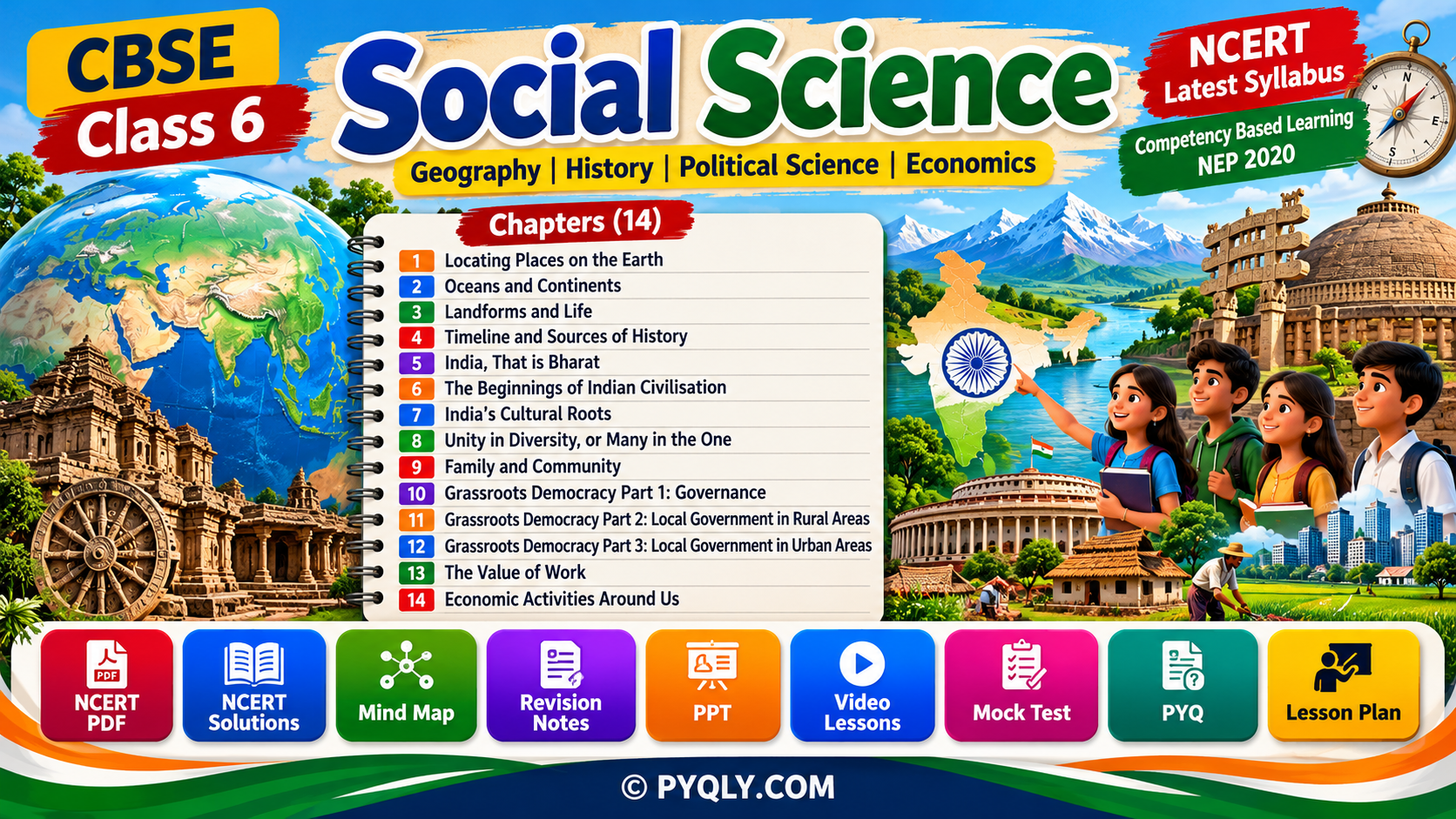
Teaching Social Science in Class 6 is an opportunity to help students understand the world around them, discover India’s rich history and cultural heritage, and learn how communities, governments and economies function. Well-planned lessons can make these connections easier to understand through discussions, maps, timelines, classroom activities and real-life examples.
These CBSE Class 6 Social Science lesson plans cover all 14 chapters in the prescribed chapter list, from locating places on Earth to understanding economic activities. Teachers can use this guide to organise classroom instruction, plan learning activities, encourage student participation and assess understanding.
For educational resources and study support, visit PYQLY.COM. Teachers should also consult the official CBSE website and NCERT website to verify the applicable curriculum, textbook editions and academic guidelines. PYQLY.COM is an independent educational resource and is not affiliated with or endorsed by CBSE or NCERT.
CBSE Class 6 Social Science Lesson Plans: Chapter-Wise Resources
This collection follows the supplied sequence of all 14 chapters. It includes geographical concepts, historical sources, Indian civilisation, cultural diversity, democratic governance, community life and economic activities.
Each chapter section can serve as a starting point for preparing a detailed teacher diary, classroom teaching plan or chapter-specific instructional resource.
How to Use These Class 6 Social Science Lesson Plans
Teachers can adapt the chapter-wise resources to their school’s timetable, students’ learning needs and the current prescribed syllabus.
- Set clear learning objectives: Identify what students should know, explain, compare or demonstrate by the end of the lesson.
- Activate prior knowledge: Begin with questions connected to students’ surroundings, experiences and familiar examples.
- Use suitable teaching aids: Incorporate maps, pictures, timelines, diagrams, local examples and textbook activities where appropriate.
- Encourage active learning: Include group discussions, short presentations, map work, role-play and collaborative tasks.
- Assess learning regularly: Use oral questions, worksheets, exit tickets, short quizzes and classroom observations.
- Plan reinforcement: Provide recap activities and additional explanations for concepts students find difficult.
Chapter-Wise Lesson Plans for CBSE Class 6 Social Science
Chapter 1: Locating Places on the Earth – Lesson Plan
This chapter introduces students to locating places and understanding geographical positions on Earth. A lesson plan can use globes, maps, directions and location-based activities to develop spatial awareness.
[PASTE ACTUAL LESSON PLAN OF CHAPTER 1 HERE]
Chapter 2: Oceans and Continents – Lesson Plan
Students explore the major oceans and continents and their positions on the world map. Teachers can use map identification, labelling exercises and geographical discussions to reinforce learning.
[PASTE ACTUAL LESSON PLAN OF CHAPTER 2 HERE]
Chapter 3: Landforms and Life – Lesson Plan
This chapter examines major landforms and how geographical conditions influence human life. Classroom activities can compare mountains, plains, plateaus and other landforms with examples of settlement and livelihoods.
[PASTE ACTUAL LESSON PLAN OF CHAPTER 3 HERE]
Chapter 4: Timeline and Sources of History – Lesson Plan
Students learn how historians understand the past through timelines and different historical sources. A lesson plan can include sequencing events, examining historical evidence and distinguishing between different types of sources.
[PASTE ACTUAL LESSON PLAN OF CHAPTER 4 HERE]
Chapter 5: India, That is Bharat – Lesson Plan
This chapter introduces students to India, its geographical identity and the names associated with the country. Teachers can use maps, historical references and guided discussions to build an understanding of India’s identity.
[PASTE ACTUAL LESSON PLAN OF CHAPTER 5 HERE]
Chapter 6: The Beginnings of Indian Civilisation – Lesson Plan
Students explore the beginnings of Indian civilisation and the evidence used to understand early human settlements. Teaching strategies may include maps, archaeological examples, artefact illustrations and comparisons of early ways of life.
[PASTE ACTUAL LESSON PLAN OF CHAPTER 6 HERE]
Chapter 7: India’s Cultural Roots – Lesson Plan
This chapter explores the cultural roots of India and traditions that have influenced society over time. Teachers can encourage thoughtful discussion, examine historical examples and connect cultural ideas with everyday life.
[PASTE ACTUAL LESSON PLAN OF CHAPTER 7 HERE]
Chapter 8: Unity in Diversity, or Many in the One – Lesson Plan
Students examine how people with different languages, customs, traditions and lifestyles share a common national identity. Classroom activities can include cultural examples, group presentations and discussions about mutual respect and unity.
[PASTE ACTUAL LESSON PLAN OF CHAPTER 8 HERE]
Chapter 9: Family and Community – Lesson Plan
This chapter helps students understand the importance of families, communities, relationships and shared responsibilities. Teachers can use familiar situations, collaborative activities and reflective questions to connect the topic with students’ experiences.
[PASTE ACTUAL LESSON PLAN OF CHAPTER 9 HERE]
Chapter 10: Grassroots Democracy Part 1: Governance – Lesson Plan
Students are introduced to governance and the role of democratic participation in collective decision-making. A lesson plan can use classroom elections, discussion activities and familiar examples of rules and responsibilities.
[PASTE ACTUAL LESSON PLAN OF CHAPTER 10 HERE]
Chapter 11: Grassroots Democracy Part 2: Local Government in Rural Areas – Lesson Plan
This chapter focuses on local government in rural areas and its role in addressing community needs. Teachers can use village-level examples, simple organisational diagrams and discussions about public services and participation.
[PASTE ACTUAL LESSON PLAN OF CHAPTER 11 HERE]
Chapter 12: Grassroots Democracy Part 3: Local Government in Urban Areas – Lesson Plan
Students learn about local government in urban areas and the management of community services. Teaching activities can explore sanitation, roads, waste management and the responsibilities of urban local bodies.
[PASTE ACTUAL LESSON PLAN OF CHAPTER 12 HERE]
Chapter 13: The Value of Work – Lesson Plan
This chapter encourages students to appreciate different forms of work and their contribution to individuals and society. Classroom discussions can highlight dignity of labour, cooperation, skills and respect for all occupations.
[PASTE ACTUAL LESSON PLAN OF CHAPTER 13 HERE]
Chapter 14: Economic Activities Around Us – Lesson Plan
Students explore economic activities in their surroundings and how people produce, distribute and use goods and services. Teachers can introduce relatable examples from households, shops, farms, markets and service providers.
[PASTE ACTUAL LESSON PLAN OF CHAPTER 14 HERE]
How to Make Class 6 Social Science Lessons More Effective
A strong teaching plan should encourage students to investigate ideas instead of simply memorising definitions. The following approaches can help teachers create meaningful learning experiences.
- Connect lessons with local surroundings: Relate landforms, livelihoods, community services and economic activities to examples students recognise.
- Integrate map and timeline work: Use geographical maps for location-based topics and timelines for historical sequencing.
- Promote collaborative learning: Assign group tasks, peer explanations and short presentations to encourage participation.
- Use inquiry-based questions: Ask students to explain why communities develop in particular places or how local governments address shared needs.
- Include formative assessment: Check understanding through brief written responses, quizzes, oral questioning and practical tasks.
- Encourage reflection: Ask students to summarise what they learned and identify how it relates to their everyday lives.
Frequently Asked Questions (FAQs)
1. What is included in the CBSE Class 6 Social Science lesson plan collection?
The collection covers all 14 chapters listed in this guide, including geography, history, cultural heritage, governance, family and community, and economic activities. Each chapter has a dedicated placeholder for adding its detailed teaching plan.
2. Who can use these Class 6 Social Science lesson plans?
Teachers, trainee teachers and educators preparing classroom instruction can use this guide as a planning framework. The resources should be adapted to the school’s timetable, students’ learning levels and the applicable curriculum.
3. How should teachers prepare a detailed lesson plan for each chapter?
A detailed plan can include learning objectives, previous knowledge, teaching-learning materials, introductory questions, teaching steps, student activities, assessment questions, homework and reflection. Teachers should select the elements that suit the chapter and the format required by their school.
4. How can teachers make Social Science interesting for Class 6 students?
Teachers can use maps, timelines, role-play, storytelling, group discussions, local examples and project-based activities. Connecting textbook concepts with familiar situations helps students understand their relevance.
5. How can teachers verify the current Class 6 Social Science syllabus?
Teachers should consult the applicable textbook edition and current curriculum information available through the NCERT website and CBSE website. Chapter titles and content should be checked against the materials prescribed for the relevant academic session.
6. Can these lesson plan resources be adapted for different classroom needs?
Yes. Teachers can adjust instructional methods, examples, activity duration and assessment strategies according to students’ prior knowledge, available resources and learning needs. Any adaptation should retain the chapter’s intended learning outcomes.
7. Are complete downloadable lesson plans available for all 14 chapters?
This article provides chapter-wise placeholders for adding the actual lesson plans; it does not itself supply downloadable lesson plan files. Check PYQLY.COM for relevant educational resources, without assuming that a particular file is available unless it has been verified.
8. How can lesson plans support competency-based learning in Social Science?
Teachers can frame tasks that require students to interpret maps, sequence historical events, compare communities, explain governance processes and apply economic concepts to everyday situations. These activities encourage understanding, reasoning and communication rather than memorisation alone.
Conclusion
Well-structured CBSE Class 6 Social Science lesson plans help teachers connect textbook concepts with meaningful classroom experiences. By planning clear objectives, suitable activities and regular assessments, educators can make all 14 chapters more accessible and engaging for students.
Use PYQLY.COM to explore relevant educational resources and consult the official CBSE and NCERT websites to confirm current curriculum requirements. Adapt every lesson plan to the prescribed textbook, students’ needs and your school’s teaching diary format.