Artificial Intelligence (AI) is becoming an important part of everyday life, from voice assistants and recommendation systems to smart devices and digital learning tools. A well-organized lesson plan helps teachers introduce these concepts to Class 6 students through relatable examples, guided discussions, hands-on activities, and responsible digital practices.
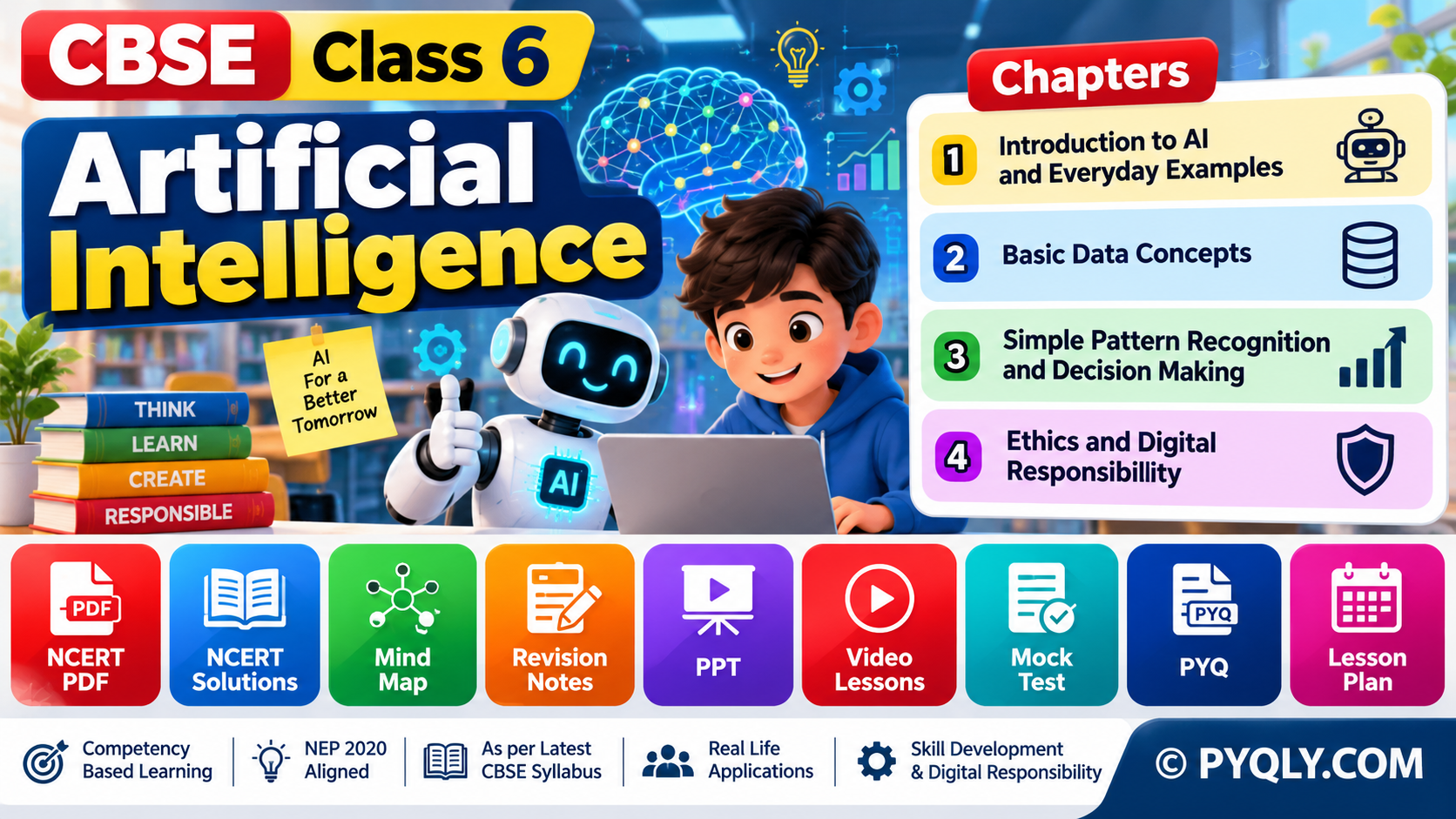
This CBSE Class 6 Artificial Intelligence lesson plan guide covers four chapters: Introduction to AI and Everyday Examples, Basic Data Concepts, Simple Pattern Recognition and Decision Making, and Ethics and Digital Responsibility. It is designed to help teachers organize classroom instruction, plan meaningful learning activities, and connect AI concepts with students’ everyday experiences.
Teachers can explore additional educational resources through PYQLY.COM and consult the official CBSE website and NCERT website to verify applicable curriculum information. PYQLY.COM is an independent educational resource website and is not affiliated with or endorsed by CBSE or NCERT.
CBSE Class 6 Artificial Intelligence Lesson Plan: Overview
A good Artificial Intelligence teaching plan should focus on understanding rather than memorization. Students at this level can begin learning how machines use data, identify patterns, make predictions, and support decisions.
Teachers should introduce concepts through familiar situations, such as searching for information online, using voice commands, recognizing objects in photographs, and receiving recommendations from digital platforms. These examples help learners understand that AI is a technology created and developed by people, rather than something that thinks and understands everything exactly as humans do.
Suggested Teaching Objectives
By working through the four chapters, students should have opportunities to:
- Explain Artificial Intelligence in simple language and identify everyday examples.
- Understand basic data concepts and why data is useful for AI systems.
- Recognize simple patterns and explain how patterns can support decision-making.
- Identify ethical concerns, protect personal information, and practise responsible digital behaviour.
- Participate in discussions, collaborative activities, and age-appropriate problem-solving tasks.
These objectives are suggested planning goals. Teachers should adapt them to the prescribed syllabus, available teaching resources, students’ prior knowledge, and the school’s academic requirements.
How to Use This Class 6 AI Lesson Plan
Use the chapter-wise sections below to organize teaching preparation. Each section provides a place to insert the actual lesson plan for that chapter, allowing teachers to maintain a consistent structure while adapting classroom delivery.
Before teaching, review the applicable curriculum and identify the intended learning outcomes. Prepare examples from students’ surroundings, select suitable activities, and plan a brief assessment to check understanding.
The placeholders below are intended for the actual lesson plans to be added by the teacher or content editor. They are not completed lesson plans or verified downloadable resources.
Chapter-Wise Artificial Intelligence Lesson Plans for Class 6
Chapter 1: Introduction to AI and Everyday Examples – Lesson Plan
This chapter introduces students to the meaning of Artificial Intelligence and its use in familiar technologies. A lesson plan can connect these concepts with everyday examples and classroom discussions that encourage curiosity.
[PASTE ACTUAL LESSON PLAN OF CHAPTER 1 HERE]
Chapter 2: Basic Data Concepts – Lesson Plan
This chapter introduces the role of data in organizing information and helping AI systems identify useful patterns. Teachers can use simple examples, such as sorting classroom objects or organizing survey responses, to make the concepts accessible.
[PASTE ACTUAL LESSON PLAN OF CHAPTER 2 HERE]
Chapter 3: Simple Pattern Recognition and Decision Making – Lesson Plan
This chapter explores how patterns can help people and computer systems classify information and make decisions. A suitable lesson plan can include sorting exercises, sequence puzzles, and discussions about how different inputs may lead to different outcomes.
[PASTE ACTUAL LESSON PLAN OF CHAPTER 3 HERE]
Chapter 4: Ethics and Digital Responsibility – Lesson Plan
This chapter encourages students to think about fairness, privacy, safety, and responsible technology use. Teachers can use age-appropriate scenarios to discuss personal information, misleading digital content, bias, and respectful online behaviour.
[PASTE ACTUAL LESSON PLAN OF CHAPTER 4 HERE]
How to Teach Artificial Intelligence Effectively in Class 6
Artificial Intelligence becomes easier to understand when students can connect abstract ideas with practical experiences. The following strategies can help teachers create an engaging learning environment.
- Begin with familiar examples: Ask students where they have encountered voice assistants, video recommendations, smart search tools, or image recognition.
- Use hands-on activities: Organize sorting, classification, and pattern-finding exercises using everyday objects, shapes, words, or numbers.
- Encourage collaborative learning: Let students work in small groups to identify patterns, compare solutions, and explain their reasoning.
- Connect data with real situations: Use a simple classroom survey to show how information can be collected, arranged, compared, and interpreted.
- Discuss responsible AI use: Encourage students to question whether information is accurate, whether personal data is protected, and whether a system’s decisions are fair.
- Assess understanding regularly: Use short oral questions, worksheets, exit tickets, and student explanations to identify misconceptions and plan follow-up activities.
- Adapt to available resources: If computers or internet access are limited, use unplugged activities that teach classification, logical reasoning, and decision-making without requiring digital devices.
Frequently Asked Questions (FAQs)
1. What is a CBSE Class 6 Artificial Intelligence lesson plan?
It is a teaching-planning document that helps a teacher organize learning objectives, explanations, activities, teaching resources, and assessments for Artificial Intelligence topics. The actual plan should be aligned with the applicable school curriculum and learning requirements.
2. Which chapters are covered in this Class 6 AI lesson plan guide?
This guide covers Introduction to AI and Everyday Examples, Basic Data Concepts, Simple Pattern Recognition and Decision Making, and Ethics and Digital Responsibility. The chapters appear in the order supplied for this article.
3. How can teachers introduce AI to Class 6 students?
Teachers can begin with familiar examples such as voice assistants, search suggestions, image recognition, and digital recommendations. Asking students to explain how these tools might work encourages curiosity and develops early computational thinking.
4. What classroom activities are suitable for teaching basic data concepts?
Students can collect simple classroom survey responses, sort objects according to their properties, create categories, and compare the results. These activities demonstrate how data can be organized and used to answer questions.
5. How can students learn pattern recognition and decision-making?
Teachers can use number sequences, shape arrangements, classification games, and everyday decision-making scenarios. Students should explain the patterns they observe and discuss whether the same rule works in every situation.
6. Why should ethics and digital responsibility be included in AI education?
AI systems can raise questions about privacy, fairness, accuracy, and the responsible use of information. Introducing these concerns early helps students develop thoughtful digital habits and understand that technology should be used responsibly.
7. How can teachers verify the applicable Class 6 AI curriculum?
Teachers should consult the official CBSE website and NCERT website for relevant curriculum documents, advisories, and learning materials. They should also follow the syllabus and instructions formally adopted by their school or educational authority.
8. Can this lesson plan guide be adapted for different classroom settings?
Yes. Teachers can adjust the pace, examples, activities, and assessment methods according to students’ prior knowledge and available resources. The chapter structure can serve as a planning framework, but the placeholders must be completed with the actual lesson plans before classroom use.
9. Does this page provide ready-made downloadable lesson plans?
The article provides a chapter-wise framework and placeholders for adding lesson plans. It does not itself establish that completed lesson plans or downloadable files are available. Any published downloads or embedded documents should be added and verified separately.
10. How can teachers combine AI lesson plans with practical learning?
Teachers can pair each lesson with a short activity, guided discussion, and assessment question. For example, students can sort data during a data lesson or evaluate a privacy scenario during a digital responsibility lesson to connect ideas with real-life situations.
Conclusion
A structured CBSE Class 6 Artificial Intelligence lesson plan can help teachers introduce AI concepts through familiar examples, practical activities, logical reasoning, and responsible technology use. The four chapter sections in this guide provide a starting framework for organizing classroom instruction and preparing detailed teaching documents.
Teachers should complete the chapter-wise lesson plan placeholders and verify the applicable curriculum through the official CBSE and NCERT websites. For additional educational resources and teaching support, visit PYQLY.COM.