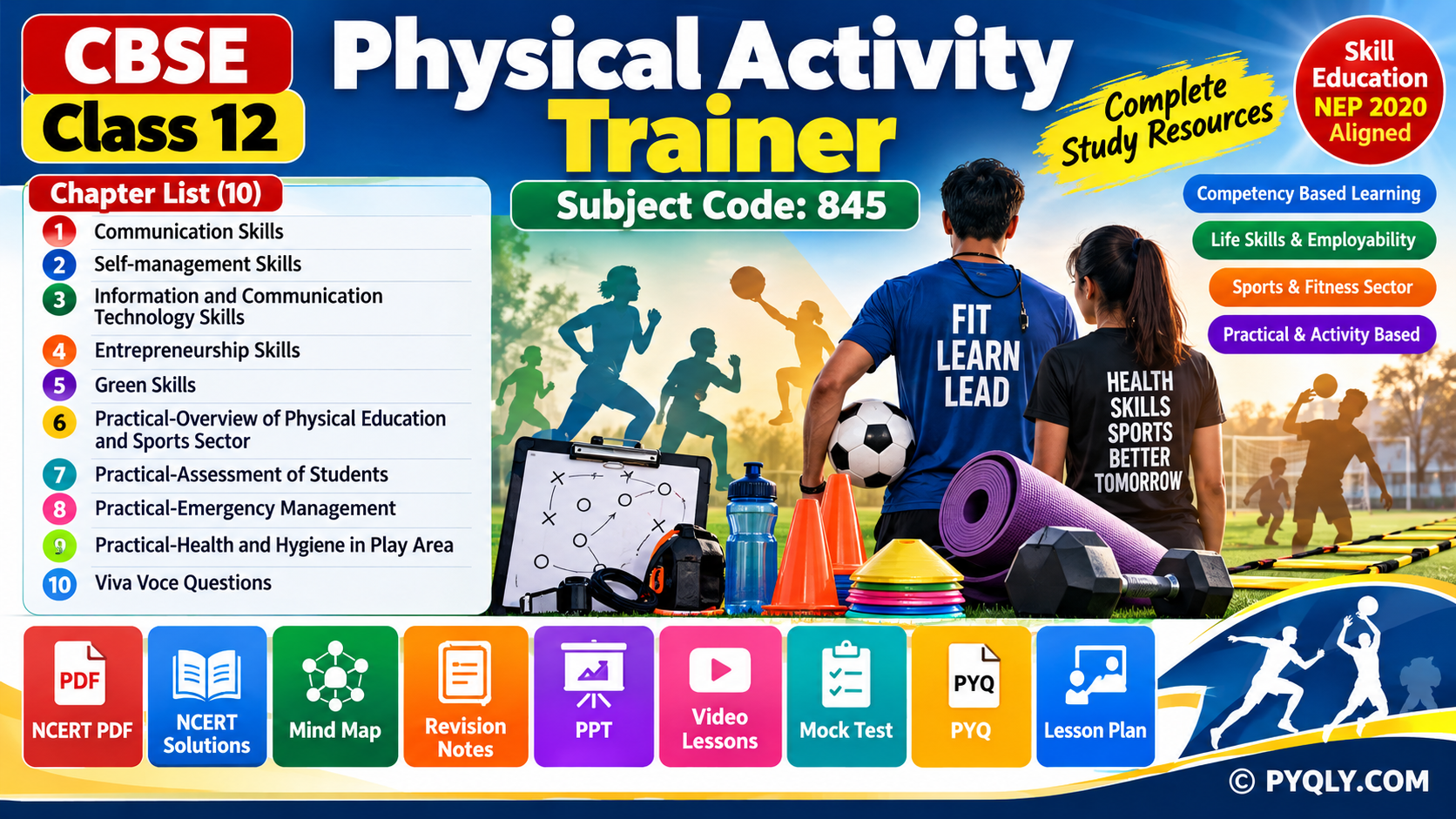
Preparing for CBSE Class 12 Physical Activity Trainer (Subject Code 845) becomes more manageable when important concepts are organised into clear, connected ideas. Chapter-wise mind maps help students revise essential terminology, understand relationships between concepts, and recall key points during written examinations, practical assessments, and viva voce preparation.
This guide covers all 10 supplied chapters, from Communication Skills and Green Skills to practical topics such as emergency management, student assessment, and hygiene in play areas. Use these mind maps as a study-planning framework alongside your prescribed learning materials.
For additional educational resources, visit PYQLY.COM. Students should also consult the official CBSE website and NCERT website to check relevant curriculum information and learning resources. PYQLY.COM is an independent educational resource platform and is not affiliated with or endorsed by CBSE or NCERT.
CBSE Class 12 Physical Activity Trainer Mind Maps: Complete Chapter-Wise Collection
Mind maps present a central topic and connect it to related ideas through branches, keywords, and short notes. For Physical Activity Trainer, this approach can help students connect workplace skills with practical responsibilities in physical education and sports.
The chapter sections below follow the supplied list in its original order. Each section includes a placeholder for adding or embedding the corresponding chapter mind map.
How to Use These Physical Activity Trainer Mind Maps
- Start with the main concept: Identify the chapter’s central topic before studying its branches.
- Follow the connections: Understand how key terms, examples, responsibilities, and procedures relate to one another.
- Recall without looking: After studying a mind map, try explaining its branches in your own words.
- Connect theory with practice: Relate workplace skills to the responsibilities of a physical activity trainer.
- Prepare for assessment: Use the maps to create short-answer questions, practical checklists, and viva voce prompts.
- Verify your syllabus: Compare your study material with the prescribed course content and guidance from your school.
Chapter-Wise Physical Activity Trainer Mind Maps
Chapter 1: Communication Skills – Mind Map
Communication Skills covers the basic ideas involved in sharing information, listening effectively, and communicating clearly with others. A mind map can help students organise communication methods, workplace interactions, and the importance of clear instructions in sports and physical activity settings.
Chapter Mind Map:
[ADD/EMBED THE CHAPTER MIND MAP HERE]
Chapter 2: Self-management Skills – Mind Map
Self-management Skills focuses on organising personal responsibilities, managing time, maintaining discipline, and working towards goals. Use a mind map to connect these skills with punctuality, motivation, confidence, and professional conduct as a physical activity trainer.
Chapter Mind Map:
[ADD/EMBED THE CHAPTER MIND MAP HERE]
Chapter 3: Information and Communication Technology Skills – Mind Map
Information and Communication Technology Skills introduces the use of digital tools to access, manage, create, and communicate information. A mind map can organise important ICT concepts and their potential applications in educational, administrative, and sports-related work.
Chapter Mind Map:
[ADD/EMBED THE CHAPTER MIND MAP HERE]
Chapter 4: Entrepreneurship Skills – Mind Map
Entrepreneurship Skills helps students explore business awareness, initiative, planning, and opportunity identification. A chapter mind map can connect entrepreneurial qualities with the planning and delivery of physical activity, fitness, and sports-related services.
Chapter Mind Map:
[ADD/EMBED THE CHAPTER MIND MAP HERE]
Chapter 5: Green Skills – Mind Map
Green Skills highlights environmental awareness and responsible practices that support sustainability. Use a mind map to organise environmental responsibilities, resource conservation, waste management, and ways to encourage eco-friendly behaviour in sports and activity spaces.
Chapter Mind Map:
[ADD/EMBED THE CHAPTER MIND MAP HERE]
Chapter 6: Practical-Overview of Physical Education and Sports Sector – Mind Map
This practical chapter introduces the Physical Education and Sports Sector and its relevant areas of work. A mind map can help students organise sector-related concepts, possible roles, activity settings, and the responsibilities associated with sports and physical activity services.
Chapter Mind Map:
[ADD/EMBED THE CHAPTER MIND MAP HERE]
Chapter 7: Practical-Assessment of Students – Mind Map
This practical chapter focuses on the assessment of students in the learning and physical activity environment. Use a mind map to organise assessment objectives, observation, performance recording, feedback, and the importance of fair and systematic evaluation, as applicable to the prescribed curriculum.
Chapter Mind Map:
[ADD/EMBED THE CHAPTER MIND MAP HERE]
Chapter 8: Practical-Emergency Management – Mind Map
Emergency Management is an important practical topic because physical activity environments may require prompt and responsible responses to unexpected situations. A mind map can help students organise emergency preparedness, hazard identification, communication, basic response procedures, and the need to follow appropriate safety and first-aid guidance.
Chapter Mind Map:
[ADD/EMBED THE CHAPTER MIND MAP HERE]
Chapter 9: Practical-Health and Hygiene in Play Area – Mind Map
This practical chapter focuses on health and hygiene considerations in play areas. A mind map can connect cleanliness, sanitation, safe equipment, waste disposal, personal hygiene, and routine inspection to the maintenance of a suitable environment for physical activities.
Chapter Mind Map:
[ADD/EMBED THE CHAPTER MIND MAP HERE]
Chapter 10: Viva Voce Questions – Mind Map
Viva Voce Questions supports oral examination preparation by helping students organise important concepts from the course. Use a mind map to connect key definitions, practical procedures, safety responsibilities, workplace skills, and examples that you can explain confidently in your own words.
Chapter Mind Map:
[ADD/EMBED THE CHAPTER MIND MAP HERE]
How to Use Class 12 Physical Activity Trainer Mind Maps Effectively
Mind maps work best when students use them actively instead of simply reading them. The following study routine can help you make revision more purposeful.
- Revise one chapter at a time: Study the relevant chapter before reviewing its mind map.
- Create keyword associations: Link each main branch to important terms, examples, or procedures from your course material.
- Practise active recall: Cover the map and reconstruct its main branches from memory.
- Connect related chapters: For example, relate Communication Skills and Self-management Skills to professional responsibilities in sports settings.
- Practise practical explanations: For student assessment, emergency management, and play-area hygiene, prepare short explanations of relevant steps and responsibilities.
- Review viva voce topics aloud: Practise answering questions clearly, accurately, and concisely.
- Check official course information: Use the resources prescribed by your school and verify relevant curriculum updates through the official CBSE and NCERT websites.
Remember that a mind map is a revision aid, not a substitute for prescribed textbooks, practical demonstrations, teacher guidance, or complete syllabus coverage.
Frequently Asked Questions (FAQs)
1. What are CBSE Class 12 Physical Activity Trainer mind maps?
They are visual study organisers that arrange the key concepts of Physical Activity Trainer (Subject Code 845) into connected branches. They can help students understand relationships between ideas and recall important information during revision.
2. How many chapters are covered in this mind map guide?
This guide covers all 10 chapters in the supplied list, including five skill-based chapters, four practical chapters, and Viva Voce Questions.
3. How can mind maps help with Physical Activity Trainer exam preparation?
Mind maps help students organise terminology, summarise key concepts, and identify topics that need further study. They are especially useful for quick revision when combined with detailed notes, textbook study, and teacher-guided practice.
4. Can these mind maps help me prepare for practical assessments?
Yes. Mind maps can help organise practical topics such as the overview of the sports sector, assessment of students, emergency management, and health and hygiene in play areas. They should be used alongside actual practical instruction and the assessment requirements prescribed by your school.
5. How should I prepare for the Viva Voce Questions chapter?
Review the key concepts from every relevant chapter and practise explaining definitions, responsibilities, procedures, and examples aloud. Focus on understanding rather than memorising answers word for word, and follow your teacher’s guidance on the prescribed viva voce syllabus.
6. Where can I verify the CBSE Class 12 Physical Activity Trainer syllabus?
Check the official CBSE website for relevant curriculum and examination information. You can also consult NCERT for applicable educational resources and follow your school’s prescribed course materials.
7. Are all the chapter mind maps available for download on PYQLY.COM?
This article provides chapter-wise placeholders for adding the relevant mind maps. Actual availability and download options must be verified on PYQLY.COM; this guide does not claim that all 10 files are already published.
8. Should I study the textbook or the mind map first?
Study the prescribed textbook or learning material first so that you understand the concepts in context. Then use the mind map to revise, test your recall, and identify topics that require additional explanation or practice.
Conclusion
CBSE Class 12 Physical Activity Trainer (Subject Code 845) requires students to understand workplace skills as well as practical responsibilities in physical education and sports. Chapter-wise mind maps can make revision more organised, strengthen connections between concepts, and support preparation for written assessments and viva voce examinations.
Use these 10 chapter sections as a framework for building or adding your mind maps, and combine them with prescribed study materials and practical learning. Explore educational resources through PYQLY.COM and verify relevant curriculum information through the official CBSE and NCERT websites.
Recommended Reads to Boost Your Grades and Career
Category 1: Entertainment & Motivation (Movies)
- Top 20 Life-Changing Movies Every Student Must Watch Before Graduating
- 20 Powerful Motivational Movies to Rewire Your Mindset and Beat Academic Burnout
- The Ultimate Student Watchlist: 20 Movies That Teach Real-World Money & Career Lessons
Category 2: Smart Study Hacks & Exam Mastery
- The 80/20 Rule for Studying: How to Score Higher by Studying Less
- How to Study for 10 Hours Without Burning Out (The Active Recall Method)
- The Ultimate Last-Minute Exam Prep Strategy: Pass Any Test in 48 Hours
- Feynman Technique: The Genius Hack to Understand Any Difficult Topic Instantly
- How to Stop Procrastinating: 5 Psychological Tricks That Actually Work for Students
- The Complete Guide to Memory Palaces: How to Remember Everything You Read in Minutes
Category 3: Spoken English & Essential Grammar (High Demand)
- How to Speak Fluent English in 30 Days: A Daily Practice Routine for Beginners
- Top 15 Most Common English Grammar Mistakes Students Make (And How to Fix Them)
- How to Stop Hesitating and Overcome the Fear of Speaking English in Public
- Master English Tenses Easily: The Simplified Guide with Real-Life Examples
- 100 Daily-Use English Sentences Every Student Should Know for College & Interviews
Category 4: Making Money & Student Finance
- 7 High-Paying Online Jobs for Students That Require Zero Investment
- How to Make Your First $500 Online as a College Student (Beginner Step-by-Step Guide)
- Top Remote Internships and High-Income Freelance Skills You Can Learn in 30 Days
- College on a Budget: How to Manage Your Money and Save Like a Pro
- Top 10 Digital Side Hustles for Teens and College Students to Start Today
Category 5: AI Tools, Tech & Productivity
- Best Free AI Tools Every Student Must Use for Assignments and Fast Research
- How to Use ChatGPT to Study Smarter, Not Harder (Actionable Prompts Included)
- Top 10 Productivity and Note-Taking Apps That Will Transform Your Grades
- How to Fact-Check and Avoid AI Detection in Academic Writing & Essays
Category 6: Career, Placements & High-Value Skills
- How to Build an Impressive Resume in College with Zero Work Experience
- Top 10 Future-Proof Skills That College Won’t Teach You (Earn More in 2026)
- How to Get High-Paying Internships at Top Companies Using LinkedIn Alone
- College Degree vs. Online Skills: What Actually Gets You Hired Today?
- From College to Career: How to Land Your Dream Job Without On-Campus Placements
Category 7: Focus, Discipline & Student Wellness
- How to Deal with Academic Burnout and Overcome Exam Anxiety
- The Ideal Daily Routine for Students: Balancing Studies, Sleep, and Social Life
- How to Build Relentless Self-Discipline: The Dopamine Detox Blueprint for Students
- Budget Travel Hacks for College Students: How to Travel on a Shoestring Budget