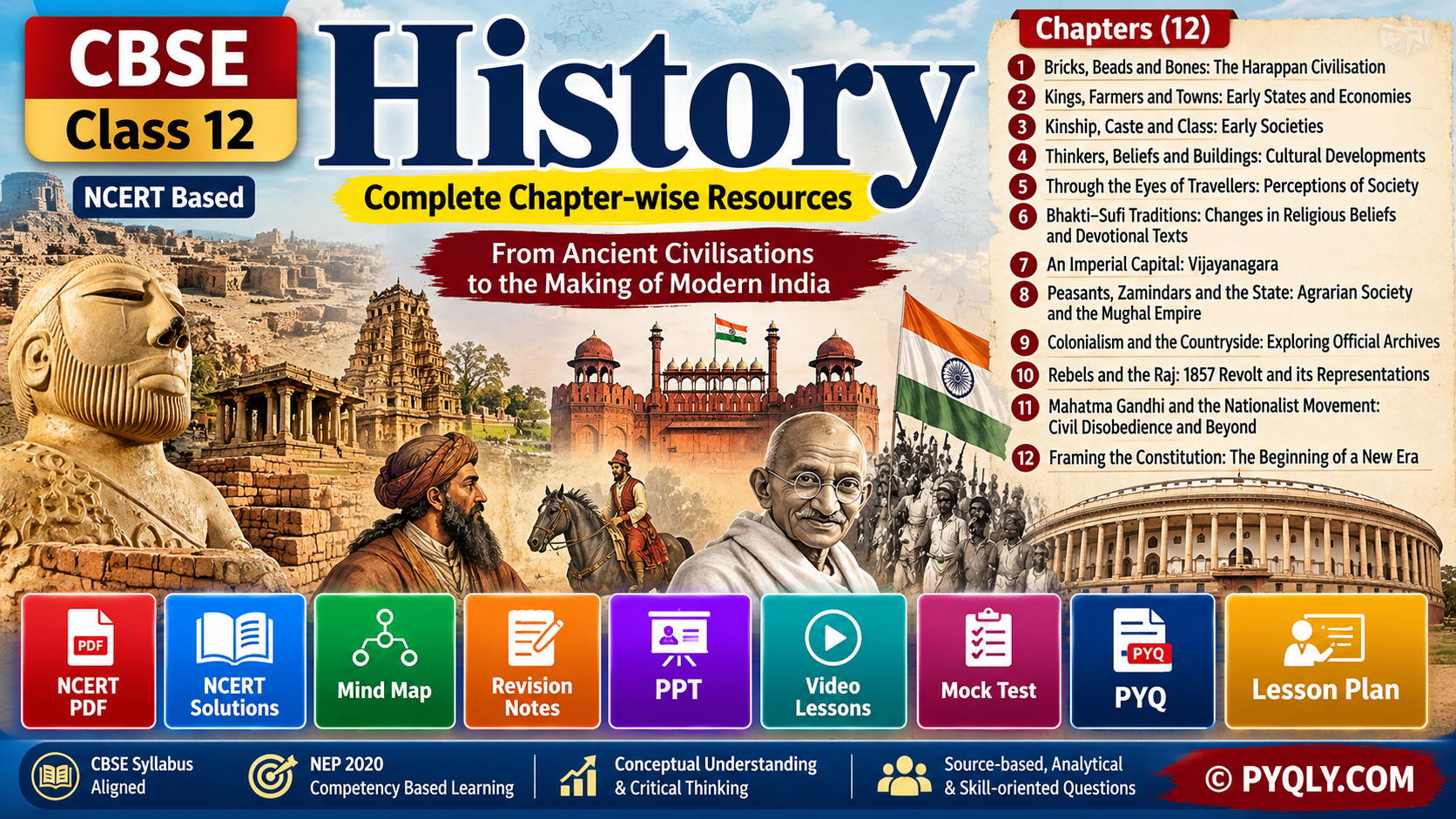
Studying History becomes easier when important events, people, sources, ideas and historical developments are organised visually. These CBSE Class 12 History mind maps are designed to help students revise all 12 chapters, connect important concepts and prepare more effectively for school examinations and board assessments.
From the Harappan Civilisation and early Indian kingdoms to Bhakti–Sufi traditions, Mughal agrarian society, colonial rule, the national movement and constitution-making, each chapter offers a different perspective on India’s past.
Visit PYQLY.COM to explore educational resources for students. For the latest curriculum and textbook information, consult the official CBSE website and NCERT website. PYQLY.COM is an independent educational resource and is not affiliated with or endorsed by CBSE or NCERT.
CBSE Class 12 History Mind Maps: Chapter-Wise Collection
This collection follows the 12 chapter titles supplied for the CBSE Class 12 History course. Each chapter section includes a placeholder where the corresponding mind map can be embedded or added after preparation and verification.
Mind maps should highlight the main historical theme, essential terms, important people, relevant sources, cause-and-effect relationships and significant developments. Students can use them alongside their prescribed NCERT textbooks rather than as a replacement for detailed reading.
How to Use Class 12 History Mind Maps
A mind map places a central topic at the centre and connects it to related ideas through branches. In History, these branches can represent chronology, political developments, economic systems, religious movements, historical evidence and different interpretations of events.
For effective revision:
- Read the corresponding NCERT chapter before studying its mind map.
- Identify the central theme and connect it to important subtopics.
- Use separate branches for dates, people, places, sources and historical developments where relevant.
- Explain each branch in your own words to check your understanding.
- Revisit the map during revision and expand any section that you find difficult to remember.
Chapter-Wise CBSE Class 12 History Mind Maps
Chapter 1: Bricks, Beads and Bones: The Harappan Civilisation – Mind Map
Explore the Harappan Civilisation through its urban settlements, town planning, craft production, trade and archaeological evidence. A well-organised mind map can connect material remains with the methods historians use to interpret this ancient civilisation.
Chapter Mind Map:
[ADD/EMBED THE CHAPTER MIND MAP HERE]
Chapter 2: Kings, Farmers and Towns: Early States and Economies – Mind Map
Revise the emergence of early states, the development of towns, agricultural production and changing economic relationships. The mind map should connect political authority, inscriptions, trade and the growth of early economies.
Chapter Mind Map:
[ADD/EMBED THE CHAPTER MIND MAP HERE]
Chapter 3: Kinship, Caste and Class: Early Societies – Mind Map
Organise the chapter’s major themes around family relationships, social hierarchy, caste, class and the interpretation of ancient texts. A visual overview can help students distinguish between prescribed social ideals and evidence about historical practices.
Chapter Mind Map:
[ADD/EMBED THE CHAPTER MIND MAP HERE]
Chapter 4: Thinkers, Beliefs and Buildings: Cultural Developments – Mind Map
Connect major religious and philosophical traditions with their teachings, institutions, monuments and archaeological sources. The mind map should help students understand how ideas developed and how historians reconstruct cultural change.
Chapter Mind Map:
[ADD/EMBED THE CHAPTER MIND MAP HERE]
Chapter 5: Through the Eyes of Travellers: Perceptions of Society – Mind Map
Compare the accounts of travellers who described Indian society from different historical and cultural perspectives. A useful mind map can organise their observations, backgrounds, descriptions and limitations as historical sources.
Chapter Mind Map:
[ADD/EMBED THE CHAPTER MIND MAP HERE]
Chapter 6: Bhakti–Sufi Traditions: Changes in Religious Beliefs and Devotional Texts – Mind Map
Revise the central ideas of Bhakti and Sufi traditions, devotional practices, important teachers, compositions and religious institutions. Connect their diverse expressions with the social and cultural settings in which they developed.
Chapter Mind Map:
[ADD/EMBED THE CHAPTER MIND MAP HERE]
Chapter 7: An Imperial Capital: Vijayanagara – Mind Map
Explore the Vijayanagara Empire through its political history, capital city, fortifications, water management, sacred spaces and architectural remains. A mind map can connect archaeological evidence and traveller accounts with the organisation of the imperial capital.
Chapter Mind Map:
[ADD/EMBED THE CHAPTER MIND MAP HERE]
Chapter 8: Peasants, Zamindars and the State: Agrarian Society and the Mughal Empire – Mind Map
Organise the Mughal agrarian system around peasants, zamindars, land revenue, agricultural production and state administration. The map should show how different groups interacted within the rural economy and how historians use contemporary records to understand it.
Chapter Mind Map:
[ADD/EMBED THE CHAPTER MIND MAP HERE]
Chapter 9: Colonialism and the Countryside: Exploring Official Archives – Mind Map
Understand colonial agrarian policies, rural society, revenue systems and the experiences of cultivators under British rule. Connect official archives with the questions historians ask about colonial administration and the limitations of government records.
Chapter Mind Map:
[ADD/EMBED THE CHAPTER MIND MAP HERE]
Chapter 10: Rebels and the Raj: 1857 Revolt and its Representations – Mind Map
Trace the major developments of the Revolt of 1857, its participants, causes, regional dimensions and consequences. A mind map can also compare colonial representations with other historical accounts and visual sources.
Chapter Mind Map:
[ADD/EMBED THE CHAPTER MIND MAP HERE]
Chapter 11: Mahatma Gandhi and the Nationalist Movement: Civil Disobedience and Beyond – Mind Map
Connect Gandhi’s political methods with major nationalist campaigns, popular participation, colonial responses and debates within the freedom movement. A chronological branch can help students distinguish important developments while examining the experiences of different social groups.
Chapter Mind Map:
[ADD/EMBED THE CHAPTER MIND MAP HERE]
Chapter 12: Framing the Constitution: The Beginning of a New Era – Mind Map
Revise the Constituent Assembly, constitutional debates, competing viewpoints and the principles that shaped independent India’s Constitution. The mind map should connect important issues with the arguments and decisions involved in constitution-making.
Chapter Mind Map:
[ADD/EMBED THE CHAPTER MIND MAP HERE]
How to Prepare for CBSE Class 12 History Exams Using Mind Maps
Mind maps are most useful when they support active learning rather than passive reading. Follow these practical strategies to strengthen your understanding of the Class 12 History syllabus.
- Build a chapter overview: After reading a chapter, write its central theme and identify the most important subtopics.
- Organise historical evidence: Keep archaeological findings, inscriptions, literary sources, official documents and traveller accounts distinct where appropriate.
- Practise chronology: Arrange significant events in sequence when the chapter involves historical developments over time.
- Connect causes and consequences: Use branches to show relationships between political, economic, religious and social changes.
- Prepare for different question formats: Use the mind map to develop answers for short-answer, long-answer and source-based questions. Check the current assessment pattern against official guidance.
- Test your recall: Hide the original map and recreate its main branches from memory. Then compare your version with the textbook and correct missing details.
Remember that mind maps provide an overview, but board-style answers require relevant evidence, accurate explanations and sufficient detail. Practise writing complete answers after revising each map.
Frequently Asked Questions (FAQs)
1. What are CBSE Class 12 History mind maps?
CBSE Class 12 History mind maps are visual summaries that organise historical themes, events, people, sources and relationships. They help students understand how different parts of a chapter connect and make revision more structured.
2. How can mind maps help with Class 12 History exam preparation?
Mind maps help students recall key ideas, organise historical information and revise large chapters efficiently. They are especially useful for reviewing relationships between events, historical interpretations and different types of evidence.
3. Should I study NCERT textbooks before using History mind maps?
Yes. Read the prescribed NCERT chapter first so that you understand the context and supporting evidence. Use the mind map afterwards to consolidate your learning and identify topics that need further study.
4. Do these mind maps cover all 12 supplied Class 12 History chapters?
The article lists all 12 supplied chapters in the specified order. The mind map placeholders need to be replaced with the corresponding chapter resources before the collection can be considered complete.
5. Can I use mind maps to prepare source-based History questions?
Yes, as a revision aid. Mind maps can help you remember the context of archaeological, literary, visual and documentary sources, but you should also practise interpreting the actual source material and supporting your answers with evidence.
6. Are mind maps enough to score well in CBSE Class 12 History?
Mind maps alone are not sufficient. Combine them with NCERT reading, source analysis, written-answer practice and revision of the current prescribed syllabus to prepare comprehensively.
7. How can I verify the current Class 12 History syllabus?
Check the official CBSE website for curriculum and examination updates and the NCERT website for textbook information. Follow the syllabus and instructions applicable to your examination session.
8. Where can I find educational resources for Class 12 History?
Visit PYQLY.COM to explore its educational resources. Check the relevant page for the specific material you need, and verify the accuracy and syllabus relevance of any resource before using it for examination preparation.
Conclusion
Effective History revision begins with understanding the past, connecting evidence and explaining historical change clearly. These CBSE Class 12 History mind maps provide a chapter-wise framework for organising the 12 supplied topics, identifying important themes and strengthening recall.
Use the maps alongside your prescribed textbooks, practise written and source-based answers, and verify current requirements through CBSE and NCERT. Visit PYQLY.COM to explore educational resources that support your learning and exam preparation.
Recommended Reads to Boost Your Grades and Career
Category 1: Entertainment & Motivation (Movies)
- Top 20 Life-Changing Movies Every Student Must Watch Before Graduating
- 20 Powerful Motivational Movies to Rewire Your Mindset and Beat Academic Burnout
- The Ultimate Student Watchlist: 20 Movies That Teach Real-World Money & Career Lessons
Category 2: Smart Study Hacks & Exam Mastery
- The 80/20 Rule for Studying: How to Score Higher by Studying Less
- How to Study for 10 Hours Without Burning Out (The Active Recall Method)
- The Ultimate Last-Minute Exam Prep Strategy: Pass Any Test in 48 Hours
- Feynman Technique: The Genius Hack to Understand Any Difficult Topic Instantly
- How to Stop Procrastinating: 5 Psychological Tricks That Actually Work for Students
- The Complete Guide to Memory Palaces: How to Remember Everything You Read in Minutes
Category 3: Spoken English & Essential Grammar (High Demand)
- How to Speak Fluent English in 30 Days: A Daily Practice Routine for Beginners
- Top 15 Most Common English Grammar Mistakes Students Make (And How to Fix Them)
- How to Stop Hesitating and Overcome the Fear of Speaking English in Public
- Master English Tenses Easily: The Simplified Guide with Real-Life Examples
- 100 Daily-Use English Sentences Every Student Should Know for College & Interviews
Category 4: Making Money & Student Finance
- 7 High-Paying Online Jobs for Students That Require Zero Investment
- How to Make Your First $500 Online as a College Student (Beginner Step-by-Step Guide)
- Top Remote Internships and High-Income Freelance Skills You Can Learn in 30 Days
- College on a Budget: How to Manage Your Money and Save Like a Pro
- Top 10 Digital Side Hustles for Teens and College Students to Start Today
Category 5: AI Tools, Tech & Productivity
- Best Free AI Tools Every Student Must Use for Assignments and Fast Research
- How to Use ChatGPT to Study Smarter, Not Harder (Actionable Prompts Included)
- Top 10 Productivity and Note-Taking Apps That Will Transform Your Grades
- How to Fact-Check and Avoid AI Detection in Academic Writing & Essays
Category 6: Career, Placements & High-Value Skills
- How to Build an Impressive Resume in College with Zero Work Experience
- Top 10 Future-Proof Skills That College Won’t Teach You (Earn More in 2026)
- How to Get High-Paying Internships at Top Companies Using LinkedIn Alone
- College Degree vs. Online Skills: What Actually Gets You Hired Today?
- From College to Career: How to Land Your Dream Job Without On-Campus Placements
Category 7: Focus, Discipline & Student Wellness
- How to Deal with Academic Burnout and Overcome Exam Anxiety
- The Ideal Daily Routine for Students: Balancing Studies, Sleep, and Social Life
- How to Build Relentless Self-Discipline: The Dopamine Detox Blueprint for Students
- Budget Travel Hacks for College Students: How to Travel on a Shoestring Budget