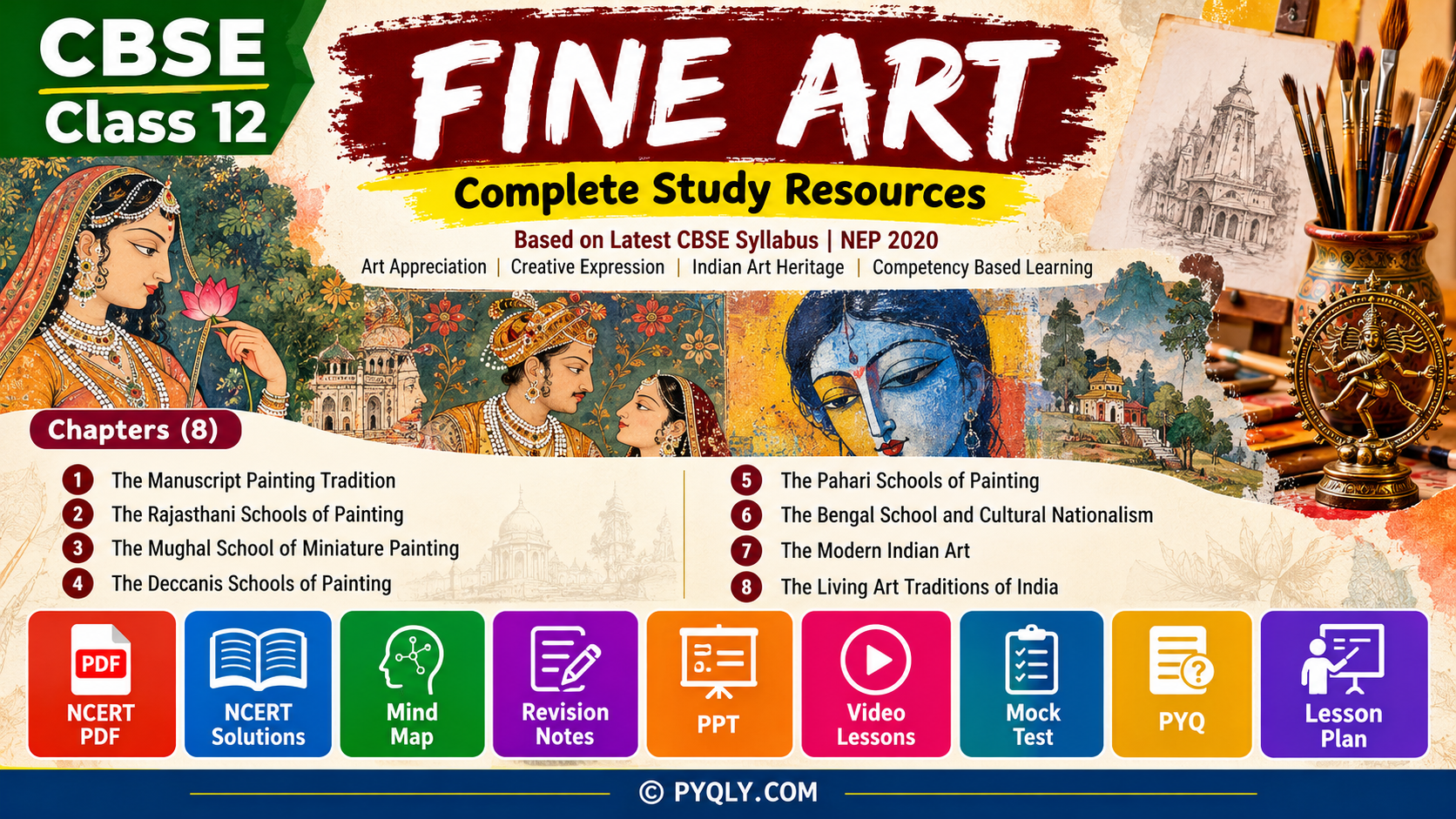
Preparing for the Class 12 Fine Art examination requires more than memorising painting names and artists. Students need to understand the development of Indian art, recognise distinctive painting styles, connect artworks with their historical backgrounds, and remember important artistic features.
These CBSE Class 12 Fine Art revision notes are organised around all eight chapters supplied in the syllabus list. They provide a structured framework for reviewing Indian manuscript paintings, miniature painting schools, cultural nationalism, modern Indian art, and living artistic traditions. Students can use this guide alongside their prescribed textbook, classroom notes, and artwork illustrations.
For more educational resources, visit PYQLY.COM. For the latest curriculum and examination information, consult the official CBSE website and NCERT website. PYQLY.COM is an independent educational resource and is not affiliated with or endorsed by CBSE or NCERT.
CBSE Class 12 Fine Art Revision Notes: Chapter-Wise Overview
The following chapter-wise revision guide helps students organise their study sessions, identify important themes, and prepare concise notes for quick revision before examinations.
Use each chapter section as a starting point. Add the specific paintings, artists, dates, locations, stylistic characteristics, and textbook examples prescribed for your academic session.
How to Use These Fine Art Revision Notes
Fine Art combines historical knowledge with visual understanding. A useful revision strategy should cover both the background of an artwork and the features that make it distinctive.
- Read the corresponding chapter in your prescribed textbook before revising the summary.
- Create a separate list of important artists, paintings, schools, locations, and historical periods.
- Study the composition, colour scheme, figures, themes, and techniques of the artworks included in your textbook.
- Compare different painting schools using tables that highlight their similarities and differences.
- Practise writing clear, structured answers and verify artwork details against reliable textbook references.
Chapter-Wise Revision Notes for CBSE Class 12 Fine Art
Chapter 1: The Manuscript Painting Tradition – Revision Notes
The manuscript painting tradition introduces students to illustrated manuscripts and the relationship between visual art, literature, religion, and historical patronage. Focus your revision on the development of manuscript illustration, its materials, visual characteristics, and important examples covered in your textbook.
[ADD THE CHAPTER-WISE REVISION NOTES HERE]
Chapter 2: The Rajasthani Schools of Painting – Revision Notes
The Rajasthani schools of painting offer an opportunity to study regional artistic traditions, distinctive compositions, colour schemes, themes, and patronage. Revise the individual schools, their characteristic features, and the artists and paintings specifically discussed in your prescribed textbook.
[ADD THE CHAPTER-WISE REVISION NOTES HERE]
Chapter 3: The Mughal School of Miniature Painting – Revision Notes
The Mughal School of Miniature Painting is important for understanding courtly art, portraiture, historical illustrations, naturalistic observation, and artistic developments under Mughal rulers. Concentrate on major artists, representative paintings, stylistic features, and the contributions of different Mughal patrons.
[ADD THE CHAPTER-WISE REVISION NOTES HERE]
Chapter 4: The Deccanis Schools of Painting – Revision Notes
The Deccani schools of painting reflect the artistic culture of the Deccan region and its distinctive courtly traditions. Revise the characteristic use of colour, decorative details, figures, themes, and the historical influences associated with the paintings covered in your textbook.
[ADD THE CHAPTER-WISE REVISION NOTES HERE]
Chapter 5: The Pahari Schools of Painting – Revision Notes
The Pahari schools of painting developed distinctive regional styles in the Himalayan foothills. Focus on the principal schools identified in your textbook, their artistic characteristics, narrative themes, landscape treatments, and important painters and paintings.
[ADD THE CHAPTER-WISE REVISION NOTES HERE]
Chapter 6: The Bengal School and Cultural Nationalism – Revision Notes
The Bengal School of Art is closely associated with the revival of Indian artistic traditions and cultural nationalism during the colonial period. Revise the historical context, leading artists, characteristic artistic approaches, and the role of art in expressing cultural identity.
[ADD THE CHAPTER-WISE REVISION NOTES HERE]
Chapter 7: The Modern Indian Art – Revision Notes
Modern Indian Art explores changing artistic ideas, new approaches to representation, and the contributions of artists to India’s evolving visual culture. Prepare notes on the major artists, representative works, artistic movements, and historical developments included in the prescribed syllabus.
[ADD THE CHAPTER-WISE REVISION NOTES HERE]
Chapter 8: The Living Art Traditions of India – Revision Notes
India’s living art traditions demonstrate how artistic knowledge, cultural practices, and community identities continue through different forms of creative expression. Revise the traditional art forms, their regional contexts, materials, techniques, cultural significance, and examples covered in your textbook.
[ADD THE CHAPTER-WISE REVISION NOTES HERE]
How to Revise Class 12 Fine Art Effectively
A consistent revision routine can help you remember artistic details and develop stronger answers. Use the following techniques throughout your preparation.
- Prepare artist-wise notes: Record each important artist’s name alongside the relevant artwork, period, and artistic contribution.
- Create painting comparison charts: Compare the Rajasthani, Mughal, Deccani, and Pahari schools through their themes, colours, composition, and distinctive features.
- Practise visual identification: Study the illustrations in your textbook and learn to connect each artwork with its correct title, artist, school, and relevant background.
- Use active recall: Close your textbook and explain an artwork’s characteristics from memory before checking your notes.
- Practise structured answers: Organise descriptive answers around identification, historical context, subject matter, composition, technique, and artistic significance wherever relevant.
- Revise regularly: Review difficult names and artwork details in short sessions rather than leaving the entire syllabus for the final day.
Frequently Asked Questions (FAQs)
1. What are CBSE Class 12 Fine Art revision notes?
CBSE Class 12 Fine Art revision notes are concise study materials that help students review the history, styles, artists, paintings, and cultural developments covered in their prescribed syllabus. They are intended to support textbook study rather than replace it.
2. How many chapters are covered in this Fine Art revision guide?
This guide covers all eight chapters provided in the chapter list, from The Manuscript Painting Tradition to The Living Art Traditions of India.
3. How should I prepare for the Class 12 Fine Art examination?
Begin with your prescribed textbook, identify important artists and artworks, revise their characteristic features, and practise answering questions in a clear and organised manner. Also check the current CBSE syllabus and assessment requirements for your academic session.
4. Which topics should I compare while revising Indian miniature painting schools?
Compare their historical backgrounds, regional contexts, patronage, subject matter, composition, colour palettes, figure treatment, and distinctive artistic features. Use the specific examples and terminology presented in your textbook.
5. Are these revision notes a replacement for the NCERT textbook?
No. This guide provides a revision framework, but students should study the prescribed textbook and classroom materials for detailed explanations, artwork reproductions, and accurate chapter-specific information.
6. How can I remember important paintings and artists more easily?
Create flashcards containing the painting title, artist, school, period, and two or three distinguishing features. Practise recalling the information without looking at the answer, and review the cards regularly.
7. How can I verify the current Class 12 Fine Art syllabus?
Visit the official CBSE website at https://www.cbse.gov.in/ and check the curriculum or academic resources relevant to your examination year. Use the NCERT website at https://ncert.nic.in/ to consult applicable textbook and educational resources.
8. Where can I find additional Fine Art study resources?
Visit PYQLY.COM to explore educational resources and study support. Check the relevant pages directly to confirm which materials are available, and use official CBSE and NCERT sources to verify curriculum requirements.
Conclusion
Consistent, chapter-wise revision can make CBSE Class 12 Fine Art easier to organise and understand. Focus on the distinctive characteristics of each painting school, the contributions of important artists, the historical context of artworks, and the cultural significance of India’s artistic traditions.
Use these CBSE Class 12 Fine Art revision notes alongside your prescribed textbook, practise recalling artwork details, and review the current syllabus before your examination. Explore educational resources at PYQLY.COM, and consult CBSE and NCERT for official curriculum information.
Recommended Reads to Boost Your Grades and Career
Category 1: Entertainment & Motivation (Movies)
- Top 20 Life-Changing Movies Every Student Must Watch Before Graduating
- 20 Powerful Motivational Movies to Rewire Your Mindset and Beat Academic Burnout
- The Ultimate Student Watchlist: 20 Movies That Teach Real-World Money & Career Lessons
Category 2: Smart Study Hacks & Exam Mastery
- The 80/20 Rule for Studying: How to Score Higher by Studying Less
- How to Study for 10 Hours Without Burning Out (The Active Recall Method)
- The Ultimate Last-Minute Exam Prep Strategy: Pass Any Test in 48 Hours
- Feynman Technique: The Genius Hack to Understand Any Difficult Topic Instantly
- How to Stop Procrastinating: 5 Psychological Tricks That Actually Work for Students
- The Complete Guide to Memory Palaces: How to Remember Everything You Read in Minutes
Category 3: Spoken English & Essential Grammar (High Demand)
- How to Speak Fluent English in 30 Days: A Daily Practice Routine for Beginners
- Top 15 Most Common English Grammar Mistakes Students Make (And How to Fix Them)
- How to Stop Hesitating and Overcome the Fear of Speaking English in Public
- Master English Tenses Easily: The Simplified Guide with Real-Life Examples
- 100 Daily-Use English Sentences Every Student Should Know for College & Interviews
Category 4: Making Money & Student Finance
- 7 High-Paying Online Jobs for Students That Require Zero Investment
- How to Make Your First $500 Online as a College Student (Beginner Step-by-Step Guide)
- Top Remote Internships and High-Income Freelance Skills You Can Learn in 30 Days
- College on a Budget: How to Manage Your Money and Save Like a Pro
- Top 10 Digital Side Hustles for Teens and College Students to Start Today
Category 5: AI Tools, Tech & Productivity
- Best Free AI Tools Every Student Must Use for Assignments and Fast Research
- How to Use ChatGPT to Study Smarter, Not Harder (Actionable Prompts Included)
- Top 10 Productivity and Note-Taking Apps That Will Transform Your Grades
- How to Fact-Check and Avoid AI Detection in Academic Writing & Essays
Category 6: Career, Placements & High-Value Skills
- How to Build an Impressive Resume in College with Zero Work Experience
- Top 10 Future-Proof Skills That College Won’t Teach You (Earn More in 2026)
- How to Get High-Paying Internships at Top Companies Using LinkedIn Alone
- College Degree vs. Online Skills: What Actually Gets You Hired Today?
- From College to Career: How to Land Your Dream Job Without On-Campus Placements
Category 7: Focus, Discipline & Student Wellness
- How to Deal with Academic Burnout and Overcome Exam Anxiety
- The Ideal Daily Routine for Students: Balancing Studies, Sleep, and Social Life
- How to Build Relentless Self-Discipline: The Dopamine Detox Blueprint for Students
- Budget Travel Hacks for College Students: How to Travel on a Shoestring Budget