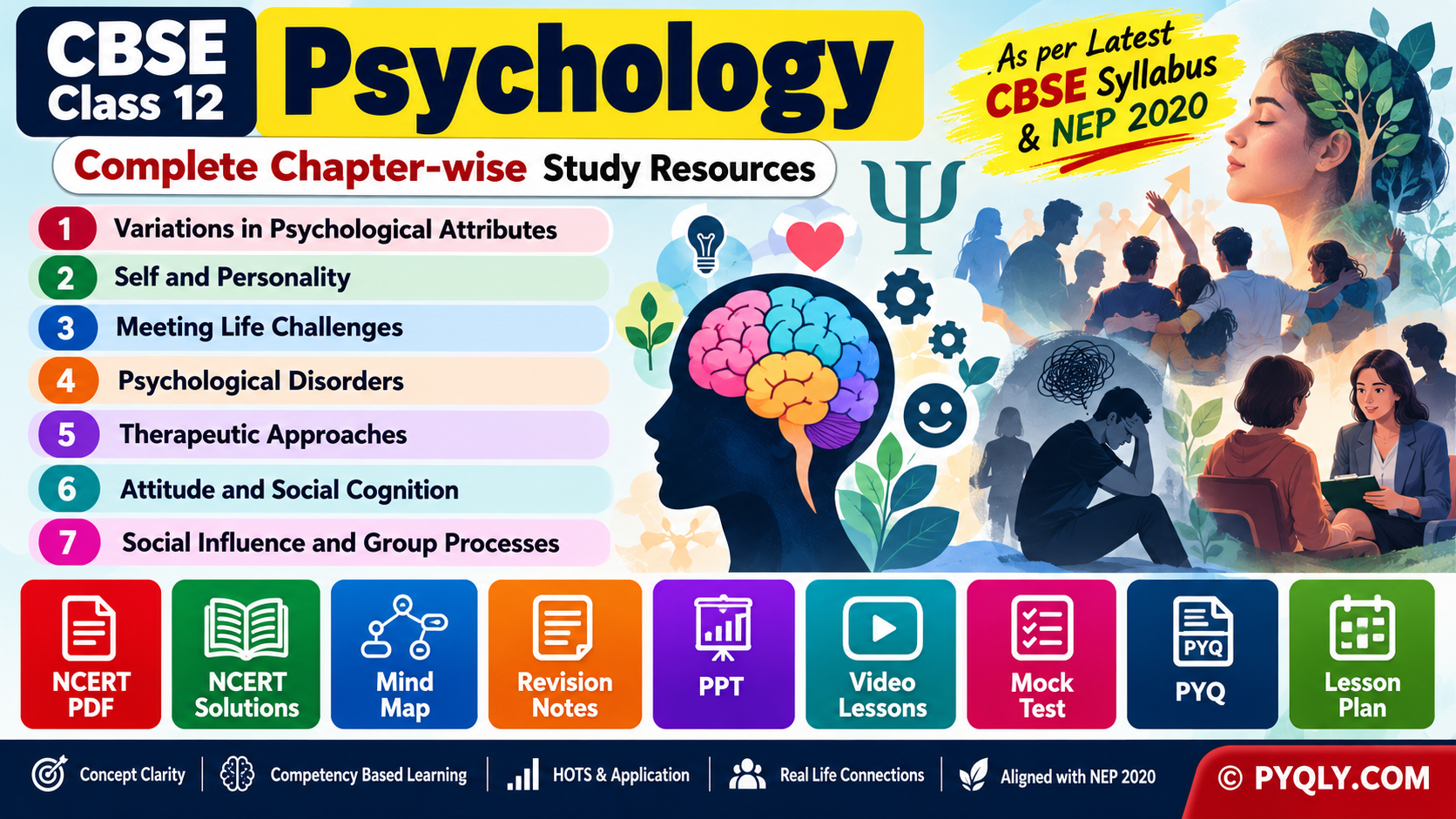
Psychology becomes easier to revise when its theories, concepts, terminology and examples are connected visually. These CBSE Class 12 Psychology mind maps are designed to help students organise important ideas from all seven chapters, identify relationships between concepts and revise more efficiently before examinations.
Explore educational resources on PYQLY.COM to support your learning. For the latest syllabus information and prescribed academic resources, consult the official CBSE website and NCERT website. PYQLY.COM is an independent educational resource platform and is not affiliated with or endorsed by CBSE or NCERT.
CBSE Class 12 Psychology Mind Maps: Chapter-Wise Collection
Mind maps provide a visual overview of a chapter by connecting its central topic with important subtopics, definitions, theories, characteristics and applications. Instead of reading long paragraphs repeatedly, students can use these connections to recall the structure of a topic and identify areas that need further study.
The following collection covers all seven chapters in the supplied Class 12 Psychology syllabus list. Use the chapter-wise placeholders to add or embed the corresponding mind maps after verifying their content against the prescribed textbook and current syllabus.
How to Use Class 12 Psychology Mind Maps
A useful Psychology mind map begins with the main chapter theme and branches into its major concepts. Smaller branches can include definitions, classifications, theorists, psychological processes, examples and links between related ideas.
For the best results, follow these steps:
- Read the corresponding NCERT chapter before using its mind map.
- Identify the main concepts, important definitions and relationships between ideas.
- Use the mind map to revise the chapter without immediately referring to the textbook.
- Explain each branch aloud in your own words to check conceptual understanding.
- Add textbook examples, important distinctions and relevant theories wherever necessary.
- Revisit difficult branches and practise writing structured answers to examination-style questions.
Chapter-Wise Psychology Mind Maps for Class 12
Chapter 1: Variations in Psychological Attributes – Mind Map
This chapter introduces individual differences in psychological attributes, including intelligence, aptitude, creativity and related assessment concepts. A mind map can help students organise the major psychological attributes, their characteristics, assessment approaches and relationships.
[ADD/EMBED THE CHAPTER MIND MAP HERE]
Chapter 2: Self and Personality – Mind Map
This chapter explores the self, personality and the different approaches used to understand individual behaviour. Use a mind map to connect major personality theories, personality assessment, self-concept and the factors associated with personality development.
[ADD/EMBED THE CHAPTER MIND MAP HERE]
Chapter 3: Meeting Life Challenges – Mind Map
This chapter examines stress, coping strategies, psychological well-being and the ways people respond to challenging situations. A visual map can organise the sources and effects of stress alongside coping mechanisms and approaches to promoting health and well-being.
[ADD/EMBED THE CHAPTER MIND MAP HERE]
Chapter 4: Psychological Disorders – Mind Map
This chapter focuses on psychological disorders, their major categories, associated symptoms and explanatory perspectives. A mind map can help students distinguish key terms, organise disorder classifications and connect relevant explanations without confusing similar concepts.
[ADD/EMBED THE CHAPTER MIND MAP HERE]
Chapter 5: Therapeutic Approaches – Mind Map
This chapter introduces approaches to psychological treatment and the principles underlying therapeutic intervention. Use a mind map to connect the major therapeutic approaches with their theoretical foundations, techniques, goals and relevant applications.
[ADD/EMBED THE CHAPTER MIND MAP HERE]
Chapter 6: Attitude and Social Cognition – Mind Map
This chapter examines attitudes, their formation and change, and the cognitive processes involved in understanding social situations. A mind map can organise the components of attitudes, attitude formation, persuasion, social cognition and attribution-related concepts.
[ADD/EMBED THE CHAPTER MIND MAP HERE]
Chapter 7: Social Influence and Group Processes – Mind Map
This chapter explores how people influence one another and how groups affect individual behaviour and decision-making. A mind map can connect group formation, group structure, social influence, cooperation, competition and other relevant group processes.
[ADD/EMBED THE CHAPTER MIND MAP HERE]
How to Prepare for Psychology Board Exams Using Mind Maps
Mind maps work best as a revision aid rather than a substitute for textbook learning. Combine visual revision with active recall, written practice and regular review.
- Start with the textbook: Understand the complete explanation of each concept before reducing it to keywords.
- Create meaningful branches: Arrange concepts hierarchically, from the central topic to supporting ideas and examples.
- Learn important terminology: Keep definitions accurate, especially when distinguishing related psychological concepts.
- Practise active recall: Cover the map and reproduce its main branches from memory.
- Prepare for written answers: Expand the keywords into clear explanations, comparisons and relevant examples.
- Check the prescribed syllabus: Verify chapter coverage and terminology using the latest information from official CBSE and NCERT resources.
Frequently Asked Questions (FAQs)
1. What are CBSE Class 12 Psychology mind maps?
CBSE Class 12 Psychology mind maps are visual summaries that organise chapter concepts, important terms and relationships into connected branches. They can help students review a chapter’s structure and recall information during revision.
2. How many chapters are covered in this Psychology mind map guide?
This guide covers all seven chapters in the supplied list, from Variations in Psychological Attributes to Social Influence and Group Processes. Each chapter has a designated placeholder for its corresponding mind map.
3. Are Psychology mind maps enough to prepare for the CBSE board examination?
No. Mind maps are revision aids, not replacements for the prescribed textbook, detailed explanations or written practice. Students should study the complete chapters and practise answering questions in the format expected by their school and board.
4. How should I revise a Psychology chapter using a mind map?
Read the chapter first, review its mind map and then try to reproduce the key branches without looking. Check your recall against the textbook and revisit concepts that you could not explain accurately.
5. Can mind maps help me remember psychological theories and terminology?
Yes. Mind maps can make relationships between theories, concepts and key terms easier to review. However, students should learn the precise meaning of each term and understand the differences between similar theories rather than memorising keywords alone.
6. Where can I verify the latest Class 12 Psychology syllabus?
Visit the official CBSE website for applicable curriculum and examination information, and the NCERT website for relevant textbook resources. Check the documents applicable to your academic session.
7. How can I make my own Psychology mind maps?
Write the main chapter topic in the centre, add branches for major concepts and create smaller branches for definitions, classifications, theories and examples. Keep the layout readable and check all information against the prescribed textbook.
8. Where can I find Class 12 Psychology study resources online?
You can explore the educational resources available on PYQLY.COM. Verify the availability and relevance of individual resources before relying on them for your preparation.
Conclusion
Chapter-wise mind maps can make CBSE Class 12 Psychology revision more organised by connecting psychological concepts, theories, definitions and examples in a visual format. Use them alongside the prescribed textbook, active recall and written practice to build a stronger understanding of all seven chapters.
Visit PYQLY.COM to explore educational resources that may support your study routine. Always verify syllabus requirements and prescribed content through the official CBSE and NCERT websites.
Recommended Reads to Boost Your Grades and Career
Category 1: Entertainment & Motivation (Movies)
- Top 20 Life-Changing Movies Every Student Must Watch Before Graduating
- 20 Powerful Motivational Movies to Rewire Your Mindset and Beat Academic Burnout
- The Ultimate Student Watchlist: 20 Movies That Teach Real-World Money & Career Lessons
Category 2: Smart Study Hacks & Exam Mastery
- The 80/20 Rule for Studying: How to Score Higher by Studying Less
- How to Study for 10 Hours Without Burning Out (The Active Recall Method)
- The Ultimate Last-Minute Exam Prep Strategy: Pass Any Test in 48 Hours
- Feynman Technique: The Genius Hack to Understand Any Difficult Topic Instantly
- How to Stop Procrastinating: 5 Psychological Tricks That Actually Work for Students
- The Complete Guide to Memory Palaces: How to Remember Everything You Read in Minutes
Category 3: Spoken English & Essential Grammar (High Demand)
- How to Speak Fluent English in 30 Days: A Daily Practice Routine for Beginners
- Top 15 Most Common English Grammar Mistakes Students Make (And How to Fix Them)
- How to Stop Hesitating and Overcome the Fear of Speaking English in Public
- Master English Tenses Easily: The Simplified Guide with Real-Life Examples
- 100 Daily-Use English Sentences Every Student Should Know for College & Interviews
Category 4: Making Money & Student Finance
- 7 High-Paying Online Jobs for Students That Require Zero Investment
- How to Make Your First $500 Online as a College Student (Beginner Step-by-Step Guide)
- Top Remote Internships and High-Income Freelance Skills You Can Learn in 30 Days
- College on a Budget: How to Manage Your Money and Save Like a Pro
- Top 10 Digital Side Hustles for Teens and College Students to Start Today
Category 5: AI Tools, Tech & Productivity
- Best Free AI Tools Every Student Must Use for Assignments and Fast Research
- How to Use ChatGPT to Study Smarter, Not Harder (Actionable Prompts Included)
- Top 10 Productivity and Note-Taking Apps That Will Transform Your Grades
- How to Fact-Check and Avoid AI Detection in Academic Writing & Essays
Category 6: Career, Placements & High-Value Skills
- How to Build an Impressive Resume in College with Zero Work Experience
- Top 10 Future-Proof Skills That College Won’t Teach You (Earn More in 2026)
- How to Get High-Paying Internships at Top Companies Using LinkedIn Alone
- College Degree vs. Online Skills: What Actually Gets You Hired Today?
- From College to Career: How to Land Your Dream Job Without On-Campus Placements
Category 7: Focus, Discipline & Student Wellness
- How to Deal with Academic Burnout and Overcome Exam Anxiety
- The Ideal Daily Routine for Students: Balancing Studies, Sleep, and Social Life
- How to Build Relentless Self-Discipline: The Dopamine Detox Blueprint for Students
- Budget Travel Hacks for College Students: How to Travel on a Shoestring Budget