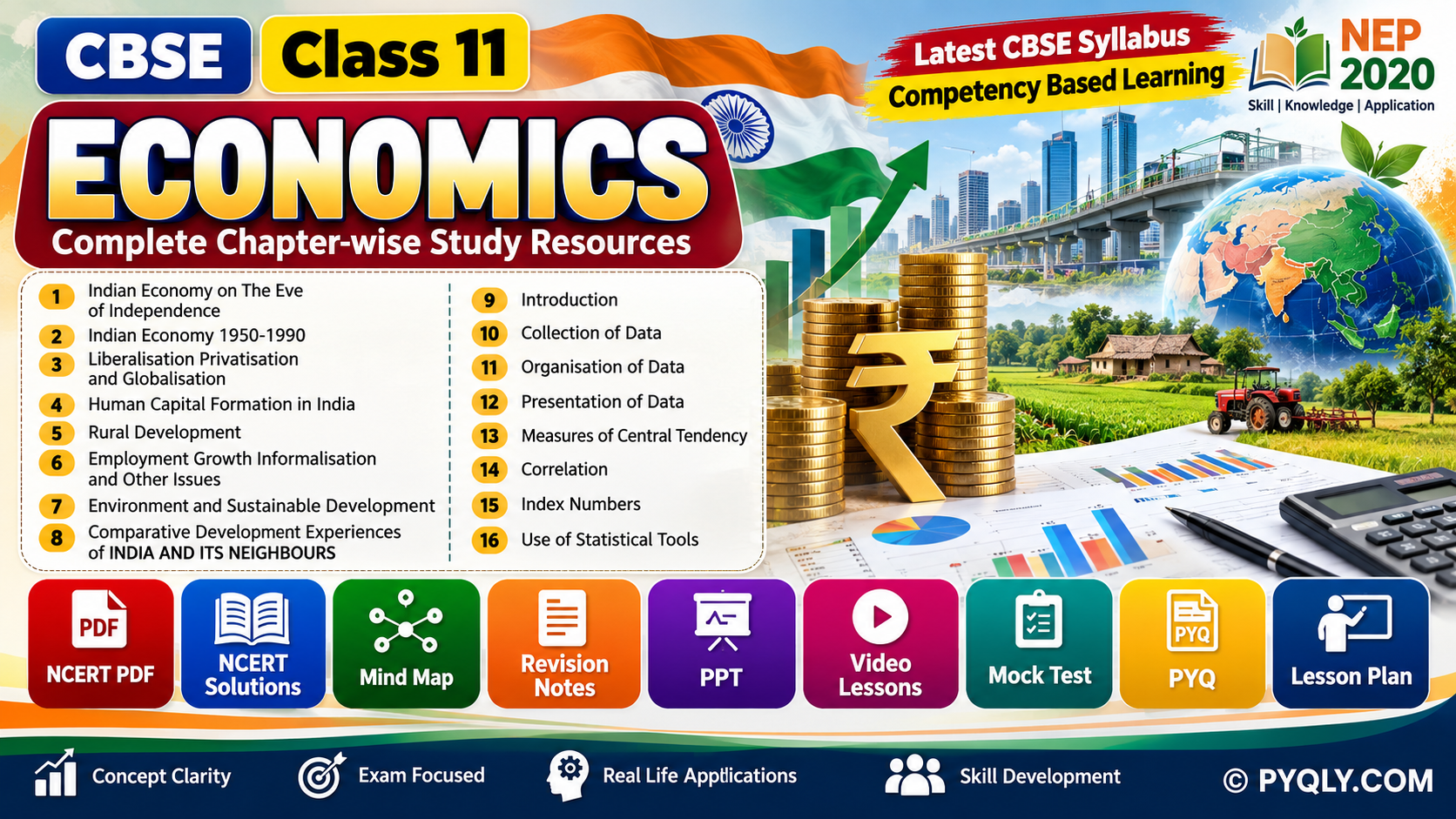
Studying Economics becomes easier when you can see how concepts, definitions, examples, and statistical methods connect with one another. These CBSE Class 11 Economics mind maps are designed to help students organise their learning, revise chapter-wise, and identify the relationships between important topics across both parts of the subject.
Whether you are studying Indian economic development or learning statistical tools, mind maps can turn lengthy chapters into structured visual outlines. Visit PYQLY.COM to explore educational resources, and consult the official CBSE website and NCERT website to check the applicable syllabus and textbook content. PYQLY.COM is an independent educational resource and is not affiliated with or endorsed by CBSE or NCERT.
CBSE Class 11 Economics Mind Maps: Chapter-Wise Collection
Class 11 Economics includes two broad areas: Indian Economic Development and Statistics for Economics. The first develops an understanding of India’s economic history, development strategies, employment, rural development, human capital, and sustainability. The second introduces data collection, organisation, presentation, and statistical techniques used to interpret economic information.
A chapter-wise mind map helps you identify the main idea, supporting concepts, important terms, and connections within each chapter. The following collection covers all 16 chapters in the order supplied.
How to Use Class 11 Economics Mind Maps
Use a mind map as a companion to your textbook rather than a replacement for it.
- Begin with the chapter’s central topic and identify its major branches.
- Connect definitions, causes, effects, characteristics, examples, and important relationships.
- For statistical chapters, include formulas, calculation steps, and the conditions under which each method is used.
- After studying a mind map, close your notes and explain the main branches from memory.
- Return to the textbook for detailed explanations, examples, numerical problems, and any prescribed activities.
- Check the current syllabus and assessment requirements using official CBSE and NCERT resources.
Part A: Indian Economic Development
Chapter 1: Indian Economy on The Eve of Independence – Mind Map
This chapter examines the condition of the Indian economy before independence, including agriculture, industry, foreign trade, occupational structure, and infrastructure. A mind map can connect colonial economic policies with their effects on production, employment, and living standards.
[ADD/EMBED THE CHAPTER MIND MAP HERE]
Chapter 2: Indian Economy 1950-1990 – Mind Map
This chapter covers India’s development strategy during the early decades after independence, including economic planning, agriculture, industrial development, and trade policy. Organise the mind map around planning objectives, policy measures, achievements, and limitations.
[ADD/EMBED THE CHAPTER MIND MAP HERE]
Chapter 3: Liberalisation Privatisation and Globalisation – Mind Map
This chapter explores the economic reforms introduced in India in 1991 and the concepts of liberalisation, privatisation, and globalisation. A mind map can distinguish the three reform measures and connect them with their objectives, implementation, and major implications.
[ADD/EMBED THE CHAPTER MIND MAP HERE]
Chapter 4: Human Capital Formation in India – Mind Map
This chapter explains how education, health, training, and skill development contribute to human capital formation and economic growth. Use a mind map to connect the sources of human capital formation with productivity, earning capacity, and national development.
[ADD/EMBED THE CHAPTER MIND MAP HERE]
Chapter 5: Rural Development – Mind Map
This chapter focuses on improving rural livelihoods through rural credit, agricultural marketing, diversification, infrastructure, and sustainable farming practices. A mind map can organise the major challenges and development measures into clear, interconnected branches.
[ADD/EMBED THE CHAPTER MIND MAP HERE]
Chapter 6: Employment Growth Informalisation and Other Issues – Mind Map
This chapter examines employment, workforce participation, unemployment, informalisation, and the changing structure of work in India. Connect key employment concepts, worker categories, employment trends, and related challenges in one revision outline.
[ADD/EMBED THE CHAPTER MIND MAP HERE]
Chapter 7: Environment and Sustainable Development – Mind Map
This chapter explores the environment’s role in economic activity, environmental degradation, resource depletion, and sustainable development. A mind map can link environmental functions, major ecological challenges, and strategies for achieving development without compromising future generations.
[ADD/EMBED THE CHAPTER MIND MAP HERE]
Chapter 8: Comparative Development Experiences of INDIA AND ITS NEIGHBOURS – Mind Map
This chapter compares the development experiences of India and its neighbouring countries, particularly China and Pakistan, through selected economic and social indicators. Organise the mind map around development strategies, demographic trends, sectoral changes, and comparative outcomes discussed in the textbook.
[ADD/EMBED THE CHAPTER MIND MAP HERE]
Part B: Statistics for Economics
Chapter 9: Introduction – Mind Map
This chapter introduces the meaning, scope, and importance of statistics in Economics, including its role in collecting, analysing, and interpreting economic information. A mind map can connect statistical methods with economic questions, practical applications, and the limitations of statistical interpretation.
[ADD/EMBED THE CHAPTER MIND MAP HERE]
Chapter 10: Collection of Data – Mind Map
This chapter explains sources of data, methods of data collection, census and sample investigations, and primary and secondary data. Use a mind map to compare data sources, collection methods, and the factors that influence the choice of an appropriate method.
[ADD/EMBED THE CHAPTER MIND MAP HERE]
Chapter 11: Organisation of Data – Mind Map
This chapter focuses on organising raw data into meaningful forms, including classification and frequency distributions. A mind map can summarise the different types of classification, frequency tables, and the basic steps involved in arranging data systematically.
[ADD/EMBED THE CHAPTER MIND MAP HERE]
Chapter 12: Presentation of Data – Mind Map
This chapter covers the presentation of statistical data through textual, tabular, and diagrammatic methods. Organise the mind map around tables, bar diagrams, pie diagrams, histograms, frequency polygons, and other graphical forms included in the prescribed textbook.
[ADD/EMBED THE CHAPTER MIND MAP HERE]
Chapter 13: Measures of Central Tendency – Mind Map
This chapter explains how a dataset can be represented by a central or typical value using measures such as arithmetic mean, median, and mode. Include the relevant formulas, calculation methods, uses, and limitations of each measure in your mind map.
[ADD/EMBED THE CHAPTER MIND MAP HERE]
Chapter 14: Correlation – Mind Map
This chapter introduces correlation as a statistical measure of the relationship between variables. A mind map can connect positive, negative, and zero correlation with scatter diagrams, correlation methods, interpretation, and the distinction between correlation and causation.
[ADD/EMBED THE CHAPTER MIND MAP HERE]
Chapter 15: Index Numbers – Mind Map
This chapter explains index numbers and their use in measuring changes in prices, quantities, and other economic variables over time. Organise the mind map around types of index numbers, construction methods, important formulas, applications, and limitations.
[ADD/EMBED THE CHAPTER MIND MAP HERE]
Chapter 16: Use of Statistical Tools – Mind Map
This chapter brings together the application of statistical tools in understanding and analysing economic data. Use a mind map to connect the relevant statistical methods with their purposes, data requirements, interpretations, and limitations as covered in your prescribed textbook.
[ADD/EMBED THE CHAPTER MIND MAP HERE]
How to Revise Class 11 Economics with Mind Maps Effectively
Mind maps work best when you actively use them to recall and explain concepts. Follow these practical steps to make your revision sessions more productive.
- Read before revising: Study the textbook section first so that the relationships in the mind map make sense.
- Recall without looking: Recreate the major branches from memory, then compare your version with your study material.
- Practise numerical questions: For Statistics for Economics, solve questions involving mean, median, mode, correlation, and index numbers wherever applicable.
- Connect concepts with examples: Relate economic development topics to examples and case studies discussed in your textbook.
- Prepare short-answer outlines: Use the main branches to organise definitions, explanations, comparisons, and longer answers.
- Review weak areas: Mark concepts you cannot explain confidently and return to the relevant textbook sections.
- Verify the syllabus: Check the current CBSE curriculum and prescribed NCERT material before finalising your examination revision plan.
Frequently Asked Questions (FAQs)
1. What are CBSE Class 11 Economics mind maps?
CBSE Class 11 Economics mind maps are structured visual outlines that organise chapter concepts, key terms, relationships, and important methods. They help students understand how individual ideas fit into the wider chapter.
2. How many chapters are included in this Class 11 Economics mind-map collection?
This collection covers all 16 chapters supplied for the article: eight chapters on Indian Economic Development and eight chapters on Statistics for Economics. Students should compare this list with the syllabus prescribed for their academic session.
3. Are Economics mind maps enough to prepare for CBSE examinations?
No. Mind maps are useful revision aids, but they do not replace the prescribed textbook, detailed explanations, numerical practice, written answers, or other assigned work. Use them alongside your regular study and revision routine.
4. How should I use mind maps for Statistics for Economics?
Begin by identifying the purpose of each statistical tool, then add its definitions, formulas, calculation steps, and interpretation. Practise numerical problems separately to develop accuracy and confidence in applying the methods.
5. How can mind maps help with Indian Economic Development?
They help you organise topics such as economic planning, reforms, employment, rural development, human capital, and sustainable development. Linking causes, policies, outcomes, and examples makes it easier to recall the structure of a topic when preparing written answers.
6. Where can I verify the current Class 11 Economics syllabus?
Visit the official CBSE website for curriculum and academic information, and the NCERT website for prescribed textbooks and related educational materials. Always follow the requirements applicable to your academic session.
7. Can I use mind maps for last-minute Economics revision?
Yes. Use them to review chapter structure, important terms, relationships, and formulas you have already studied. Spend additional time on concepts you cannot explain from memory and practise questions that require calculations or detailed reasoning.
8. Are downloadable PDF mind maps available for all 16 chapters?
The placeholders in this article identify where the relevant chapter mind maps can be added. A downloadable PDF should only be advertised after the corresponding resource has been created, verified, and made accessible.
9. How can I make my own Economics mind maps?
Write the chapter title in the centre of a page and create branches for major concepts. Add short definitions, supporting ideas, formulas, examples, and links between related topics, keeping the layout readable and consistent with your textbook.
10. What is the best way to combine mind maps with NCERT textbooks?
Read the relevant textbook section, review the mind map, and then explain the concepts without referring to either resource. Finally, solve textbook questions and numerical exercises to check whether you can apply what you have learnt.
Conclusion
CBSE Class 11 Economics becomes more manageable when you organise concepts into meaningful connections and revise them regularly. These 16 chapter sections provide a structured starting point for building a complete set of mind maps covering Indian Economic Development and Statistics for Economics.
Use mind maps alongside textbook study, numerical practice, and written-answer preparation. Explore educational resources through PYQLY.COM, and verify the applicable syllabus and prescribed content through CBSE and NCERT. Consistent revision and active recall can help you develop a stronger understanding of Economics.
Recommended Reads to Boost Your Grades and Career
Category 1: Entertainment & Motivation (Movies)
- Top 20 Life-Changing Movies Every Student Must Watch Before Graduating
- 20 Powerful Motivational Movies to Rewire Your Mindset and Beat Academic Burnout
- The Ultimate Student Watchlist: 20 Movies That Teach Real-World Money & Career Lessons
Category 2: Smart Study Hacks & Exam Mastery
- The 80/20 Rule for Studying: How to Score Higher by Studying Less
- How to Study for 10 Hours Without Burning Out (The Active Recall Method)
- The Ultimate Last-Minute Exam Prep Strategy: Pass Any Test in 48 Hours
- Feynman Technique: The Genius Hack to Understand Any Difficult Topic Instantly
- How to Stop Procrastinating: 5 Psychological Tricks That Actually Work for Students
- The Complete Guide to Memory Palaces: How to Remember Everything You Read in Minutes
Category 3: Spoken English & Essential Grammar (High Demand)
- How to Speak Fluent English in 30 Days: A Daily Practice Routine for Beginners
- Top 15 Most Common English Grammar Mistakes Students Make (And How to Fix Them)
- How to Stop Hesitating and Overcome the Fear of Speaking English in Public
- Master English Tenses Easily: The Simplified Guide with Real-Life Examples
- 100 Daily-Use English Sentences Every Student Should Know for College & Interviews
Category 4: Making Money & Student Finance
- 7 High-Paying Online Jobs for Students That Require Zero Investment
- How to Make Your First $500 Online as a College Student (Beginner Step-by-Step Guide)
- Top Remote Internships and High-Income Freelance Skills You Can Learn in 30 Days
- College on a Budget: How to Manage Your Money and Save Like a Pro
- Top 10 Digital Side Hustles for Teens and College Students to Start Today
Category 5: AI Tools, Tech & Productivity
- Best Free AI Tools Every Student Must Use for Assignments and Fast Research
- How to Use ChatGPT to Study Smarter, Not Harder (Actionable Prompts Included)
- Top 10 Productivity and Note-Taking Apps That Will Transform Your Grades
- How to Fact-Check and Avoid AI Detection in Academic Writing & Essays
Category 6: Career, Placements & High-Value Skills
- How to Build an Impressive Resume in College with Zero Work Experience
- Top 10 Future-Proof Skills That College Won’t Teach You (Earn More in 2026)
- How to Get High-Paying Internships at Top Companies Using LinkedIn Alone
- College Degree vs. Online Skills: What Actually Gets You Hired Today?
- From College to Career: How to Land Your Dream Job Without On-Campus Placements
Category 7: Focus, Discipline & Student Wellness
- How to Deal with Academic Burnout and Overcome Exam Anxiety
- The Ideal Daily Routine for Students: Balancing Studies, Sleep, and Social Life
- How to Build Relentless Self-Discipline: The Dopamine Detox Blueprint for Students
- Budget Travel Hacks for College Students: How to Travel on a Shoestring Budget